Tongyeong, South Korea: the harbor that inlays its own bay

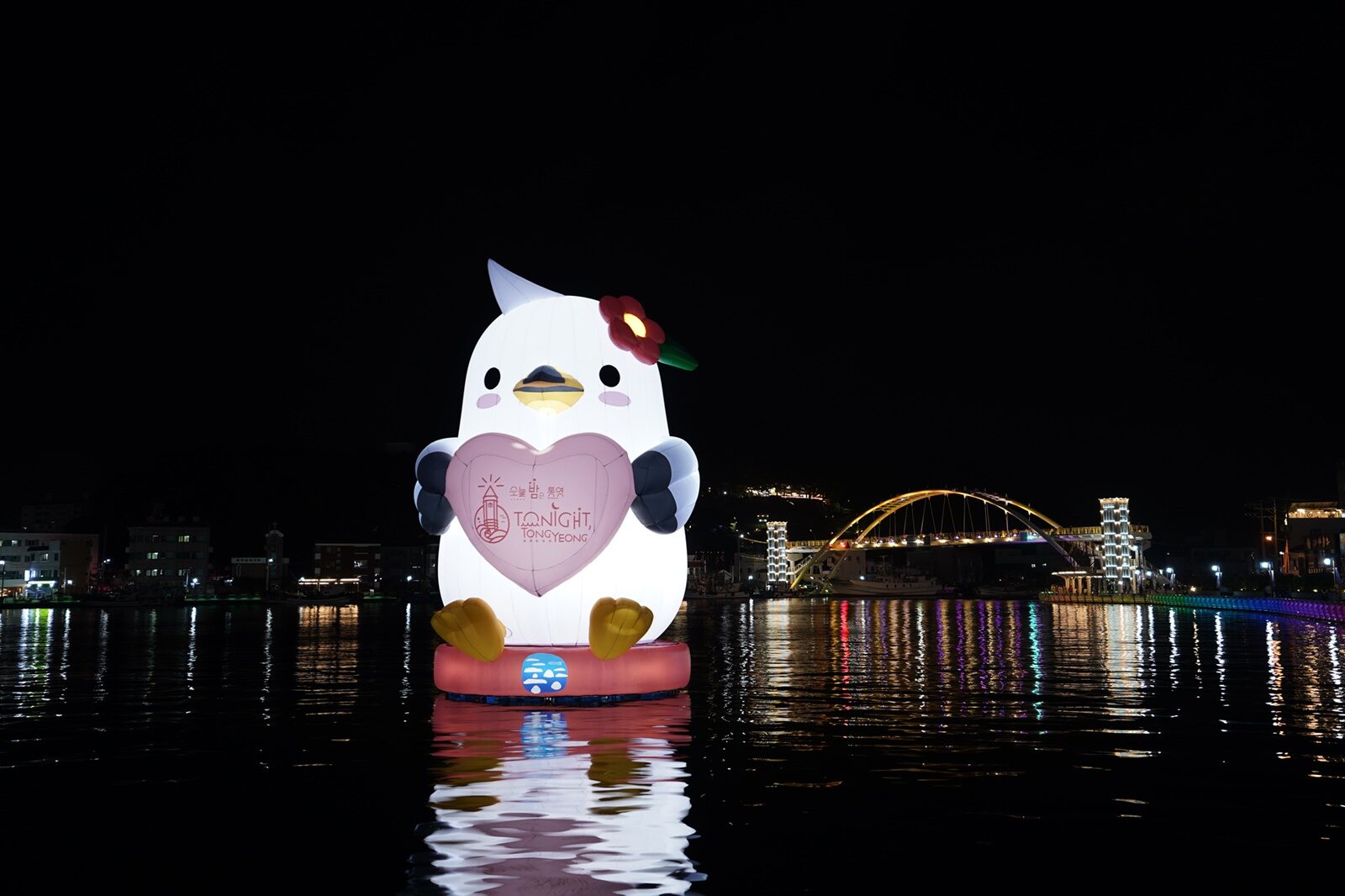

A city whose craft is the byproduct of its dinner table is rarer than a city that performs craft for visitors. Tongyeong (통영) has been inlaying mother-of-pearl for four centuries. About 118,000 people sat on the resident register at the end of 2024, or 123,475 if you count foreigners the way the encyclopedia does. The habit dates from 1604, when the naval command sat here and needed objects. The same water still feeds the city. The shells the heritage people call finest are southern-coast and Jeju.
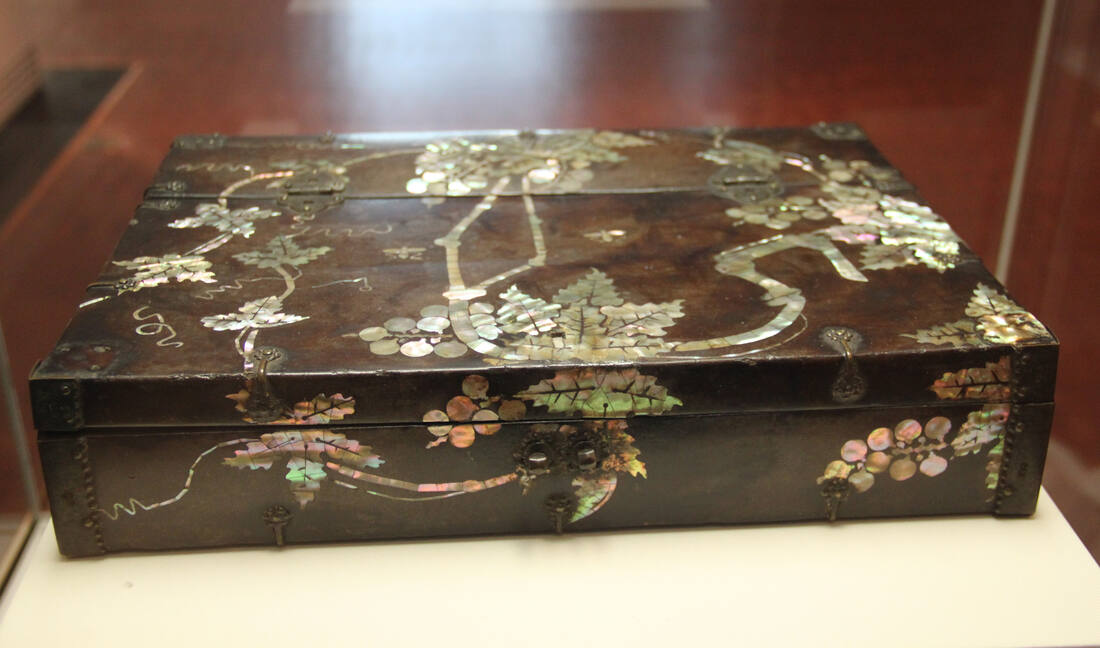
I have not been there. I have been reading from a desk, which is its own kind of knowing, and the object I keep turning over is kkeuneumjil (끊음질), Tongyeong’s thread-cut inlay: nacre sliced into strips as thin as thread and set into lacquer. I like a place whose art is made of the thing it eats. That line was the whole pull. The rest of the note I had on file was scenery I had not checked: a navy in 1603, 150 islands off the harbor mouth. The Tongyeong-si encyclopedia article says 1604, an administrative island count of 570, and a fishing city that starts with anchovy.
The marketing has called the city the Naples of the East, Dongyang-ui Napoli (동양의 나폴리). The cable car and Dongpirang (동피랑) are the postcard. The workshops, Gangguan (강구안), the inner harbor, and the market are the city I want.
Sibigongbang
The city’s name is a shortening of tongjeyeong (통제영), the Three Provinces Naval Command. In 1593 Yi Sun-sin was appointed the first samdo sugun tongjesa, commander of the three-provinces navy, and the command sat on Hansando. In 1604 the commander Yi Gyeong-jun moved it to Duryongpo, in the old harbor district (Jungang-dong and Munhwa-dong; the standing hall sits in Munhwa-dong). The Tongyeong-si article in the Encyclopedia of Korean Culture, last revised in November 2025, writes 1604. The encyclopedia’s own Tongjeyeong article still writes 1603 for the same move, and so does some of the journalism, Hankook Ilbo among it. CHA Korean splits the work: site-clearing in 1603, the relocation in 1604. The city’s English historic-sites page uses 9 September 1604. I’m using 1604 as the year the command sat here, and I’m not pretending the files agree.
Yi is how the city got a name and a headquarters. He is not why I’m still on the page. The headquarters is a cause. The remaining question is the workshops.
The command needed objects. Sibigongbang (십이공방) is the name the city still uses for the workshops that supplied the headquarters: lacquer, inlay, wood, the inventory a navy and a court actually use. The city’s own tourism page says the twelve in the name is rhetorical for many workshops. The craft that outlived the command is najeonchilgi (나전칠기), lacquerware inlaid with mother-of-pearl. The encyclopedia still names it among the city’s specialty manufactures. A headquarters eats through chests and boxes the way a harbor eats through fish. The workshops were supply.

The command’s large wooden hall, Sebyeonggwan, went up in 1605, nine bays by five, now a National Treasure. That is the encyclopedia and the city. CHA English dates the hall itself to 1604. I’m not going for the hall.
Korea Heritage Agency’s profile of the najeonjang (나전장), the inlay artisan, Lee Hyeong-man (born Tongyeong-gun, 1946; named a bearer in 1996) describes two techniques. Kkeuneumjil is the thread. Jureumjil (주름질), also written juleumjil, is the cut-out: motifs sawn from shell and laid as shapes. One is a line. The other is a shape. I keep preferring the line, which is an idle preference from a person who has never seen either done. The lacquer underneath is ottchil (옻칠), sap from the sumac. The 2011 UNESCO file put Tongyeong at the center for the inlay and Wonju for the lacquer, which is a useful split. Shell is a coast problem. Lacquer is a tree problem.
Southern-coast and Jeju shells are the ones the heritage people call finest. That is the official reason Tongyeong’s najeon has a reputation. I’ll own a tighter one. Plenty of places import a material and put it behind glass. Tongyeong’s inlay exists because a navy needed the work on a coast that already had the shells. The art started downstream of a catch. Jeju is in the same heritage sentence. I am not picking the boat.
The city in its present municipal shape is recent. In 1995 Chungmu-si and Tongyeong-gun merged. Lee Hyeong-man was born in the county. I don’t know whether he is one of the two holders the city named in 2025. The profile does not say.
The documented training line I have is a Gyeongsangnam-do najeon training center in 1951. Sibigongbang was a headquarters getting through its inventory. The 1951 center is a province trying to keep the craft in the room. I don’t have the class list from here.
The referral
On 29 June 1966 the state designated najeonjang as Important Intangible Cultural Heritage. Sixty years on the books. The city’s own English page for its Intangible Cultural Preserving Association still lists najeonjang among the technical holders.
In Bali in 2011, UNESCO’s Intergovernmental Committee looked at file 00459, “Craftsmanship of Najeon, mother-of-pearl inlay.” They found R.2 through R.5 satisfied. R.1 they judged insufficient. They wanted the social and cultural functions of the craft, past the commercial ones. The nomination was referred. It was not inscribed.
I keep agreeing with the committee, which is an odd position for a longing essay. I want the workshops because they are still attached to a catch, if they are. If najeon is only a souvenir of a navy, the referral was right to stall. A referral is more interesting than a listing. A listing would have closed the sentence. The referral left a question hanging over the city: what is this for, besides selling it.
The numbers around that question are the part I trust only as a claim. Yonhap, reporting the 2013 opening of the Tongyeong Najeonchilgi Workshop in Misu-dong, quoted a living memory the city has repeated: when Tongyeong had a little over 40,000 people, more than a thousand najeon craftspeople worked there. That is a memory someone told a reporter. It is not a census. The same Yonhap report, and the city’s blog after it, give twenty-five processes, and thirty days to a year depending on the object. That is what the city and Yonhap say. I have not counted either. I have been trying to imagine the town that memory is pointing at, and I cannot make the picture hold as a studio. It holds as a neighborhood.
Yonhap and the city also put a Craft12 project in 2008, a nod at sibigongbang. As of September 2025, KNN has the city culture office saying two najeonjang holders remain in Tongyeong, and the city is still funding a transmission hall and a workshop. That is a Tongyeong count, not a national one. Park Jae-sung and Jang Cheol-young were both designated national kkeuneumjil holders on 1 February 2023, about two and a half years before that report. Those are the Tongyeong thread-cut names I have. The same designation day also named Choi Sang-hoon, in Seongdong-gu, Seoul, and Lee Hyeong-man remains a national bearer for jureumjil in Wonju. I am not treating two Tongyeong names as the last two in the country.
A 2022 Korea Herald interview had the curator Cho Hye-young saying najeon is famous here because of the coast, which I believe, and that only one artisan was left, which I’m not using. It is too clean against the 2025 city statement of two. Cho also pointed at a neighborhood people loosely call 12 Studios. I don’t have a door number. Misu-dong is the neighborhood Yonhap named. 12 Studios is the name the triennale used. That is as close as a desk gets.
From more than a thousand in living memory to two holders does not need a metaphor. The craft nearly ended.
I have not stood in a najeonbang, a najeon workshop, and watched kkeuneumjil. I cannot tell you what the shell sounds like under the knife, or whether the remaining holders still work from the bay’s own catch. That is the cost of writing this from a desk.
Gangguan
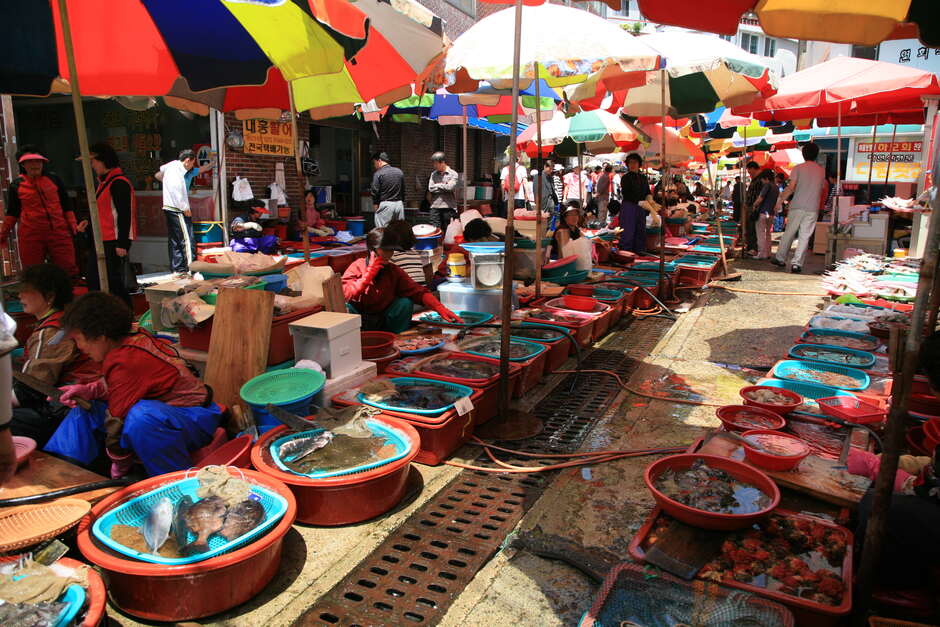
The inner harbor is Gangguan. Hankook Ilbo put the old command a short walk from it, through the market. I have not measured it. A short walk through a market is the distance at which inlay and anchovy belong to each other. I have been staring at that walk longer than is reasonable.

Beyond the harbor mouth is the Hallyeosudo (한려수도), the island-dotted waterway. The encyclopedia’s administrative count is 570 islands in the city’s waters, 43 of them inhabited. Other inventories run lower. Tourist copy prefers a rounder 150. I’m using the encyclopedia, and I’m not pretending it’s the only official number.
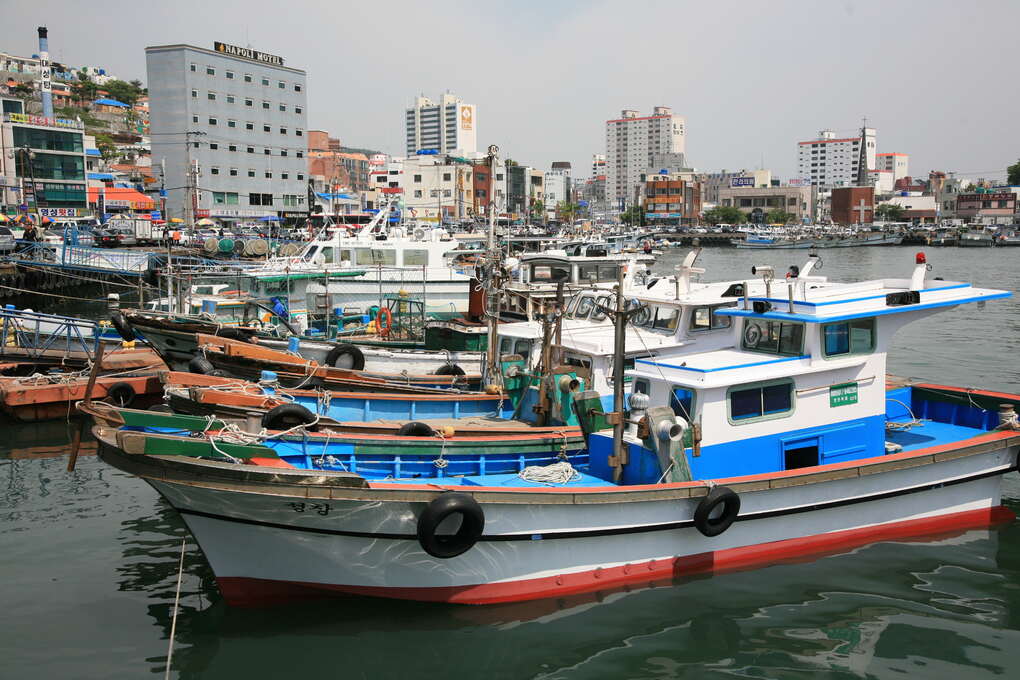

The same encyclopedia still files Tongyeong as a fishing city first. It still files Tongyeong as producing more than half of the nation’s anchovy, myeolchi. I have not independently counted the ministry share. Oyster is the other catch the city is known for. I am not printing a national share for it. The encyclopedia’s oyster figure and the city’s don’t agree. Sea squirts, meongge: Tongyeong waters were among the first Korean sites to farm them in the 1970s. Geoje has a parallel claim in the same local history, so I’m not calling Tongyeong the only first. The encyclopedia’s 2022 count still has the fishing households and boats in the thousands. I still want the boats. The catch I can stand on is anchovy and oyster, and I’m naming those two until I can stand at the dock.
Pearl-oyster aquaculture, which the encyclopedia dates from the 2000s, is a different industry from najeon. I’m not folding them together. The heritage profile talks about southern-coast and Jeju shells, not about a pearl farm.
There is no railway in the city. There is no airport. Ferries leave from the passenger terminal in Seoho-dong for Hansando and the farther islands. A town you cannot arrive at by accident of rail can keep a market for itself. I don’t know if Gangguan has. I know the encyclopedia still had the boats in the thousands in 2022.
The desk cannot answer the only question that would settle this. Do the two remaining najeonjang still buy shell off the boats at Gangguan, or does Jeju arrive in a crate? I would walk into a workshop with that and nothing else.
The facts
Tongyeong sits on the south coast of South Gyeongsang Province, South Korea. No airport, no train. The practical international gateway is Gimhae (PUS) near Busan, then an intercity bus. Sacheon (HIN) is closer and mostly domestic. I have not run the transfer, and I will not invent a timetable I have not sat through. Ferries leave from Tongyeong Passenger Terminal in Seoho-dong. City tourism and the ferry operator put Hansando and Jeseungdang at about thirty minutes. The inner harbor is Gangguan. The old command is a short walk through the market. I have no season to recommend. I have not been there in any of them. I cannot tell you a workshop’s hours from here, and I do not have posted hours that make the market a dawn appointment.
Sources
- Photo: Intkorea, CC BY-SA 4.0 · img/hero.jpg
- Photo: Gary Lee Todd, CC BY-SA 4.0 · img/najeon-box.jpg
- Photo: Junho Jung, CC BY-SA 3.0 · img/jungang-market.jpg
- Photo: Junho Jung, CC BY-SA 3.0 · img/tongyeong-port-ships.jpg
- https://encykorea.aks.ac.kr/Article/E0059371
- https://www.tyib.kr/news/articleView.html?idxno=10608
- https://www.tongyeong.go.kr/
- https://encykorea.aks.ac.kr/Article/E0059416
- https://www.tongyeong.go.kr/eng/02802/02835/02850.web?amode=view&idx=37
- https://www.khan.co.kr/article/202502182058015
- https://www.newswire.co.kr/newsRead.php?no=997983
- https://www.yna.co.kr/view/AKR20131127154400052
- https://www.utour.go.kr/00194/00198/00218.web
- https://korean.visitkorea.or.kr/detail/rem_detail.do?cotid=4fdd4144-03cf-44bc-afe0-ef5e05d5eea6
- https://folkency.nfm.go.kr/topic/detail/9875
- https://www.koreaherald.com/article/2845513
- https://www.koreatimes.co.kr/lifestyle/arts-theater/20220120/1st-tongyeong-triennale-promotes-port-city-as-hub-of-arts-crafts
- https://english.cha.go.kr/chaen/search/selectGeneralSearchDetail.do?mn=EN_02_02&sCcebKdcd=11&ccebAsno=0003050000000&sCcebCtcd=38&pageIndex=32
- https://heritage.go.kr/heri/cul/culGuidePostDetail.do?ccbaCpno=1113803050000&ccgbGbtype=IND&ccgbGbtypeNo=1&pageNo=1_5_0_0
- https://chf.or.kr/brd/board/1476/L/menu/1477?brdType=R&thisPage=1&bbIdx=117323&searchField=&searchText=
- https://nihc.go.kr/planweb/board/view.9is?dataUid=fb0db99570e2feb301710514ef874805&boardUid=ff8080816ed8ebd3016ee88d76f100eb
- https://www.doopedia.co.kr/doopedia/master/master.do?_method=view&MAS_IDX=101013000775425
- https://chf.or.kr/brd/board/1476/L/menu/1477?brdType=R&thisPage=1&bbIdx=117323
- https://english.cha.go.kr/chaen/search/selectGeneralSearchDetail.do?ccebAsno=0000100000000&sCcebKdcd=17
- https://ich.unesco.org/en/decisions/6.COM/13.40
- https://ich.unesco.org/en/13-representative-list-00411?id=00459&include=slideshow_inc.php
- https://korean.visitkorea.or.kr/detail/rem_detail.do?cotid=f26461c1-008a-46a3-8c4f-1a3d3fc6367e
- https://www.wonju.go.kr/tour/viewTnResrceDataT.do?resrceNo=4745
- https://dh.aks.ac.kr/~heritage/wiki/index.php/%EA%B2%BD%EC%83%81%EB%82%A8%EB%8F%84%EB%A6%BD_%EB%82%98%EC%A0%84%EC%B9%A0%EA%B8%B0_%EA%B8%B0%EC%88%A0%EC%9B%90_%EC%96%91%EC%84%B1%EC%86%8C
- https://www.heritage.go.kr
- https://www.tongyeong.go.kr/eng/02804/02874/03249.web
- https://webarchive.unesco.org/web/20151208152600/http:/www.unesco.org/culture/ich/en/6com
- https://m.blog.naver.com/tongyeongsi/223059991918
- http://www.craft12.co.kr/shop/
- https://news.knn.co.kr/news/article/177384
- https://www.ohmynews.com/NWS_Web/View/at_pg.aspx?CNTN_CD=A0002899165
- https://www.sd.go.kr/pr/webNewsToolDetail.do?key=5091&subNo=19558
- https://korean.visitkorea.or.kr/detail/rem_detail.do?cotid=4164b0e3-4a31-4ea6-9056-085ff86697d4
- https://en.yna.co.kr/view/AEN20160824005600315
- https://www.gyeongnam.go.kr/gnisland/index.gyeong?menuCd=DOM_000004202000000000
- https://www.idomin.com/news/articleView.html?idxno=414485
- https://www.yeongnam.com/web/view.php?key=20200402010000355
- https://www.tongyeong.go.kr/eng/02805/02884/03098.web
- http://www.hansando-ferry.co.kr/
- https://www.travelmath.com/nearest-airport/Tongyeong,+South+Korea
- https://vocados.github.io/en/bus-schedules/kim-hae-to-tongyeong/
- https://bustrain.kr/intercitybus/689
- https://en.wikipedia.org/wiki/Sacheon_Airport
- https://www.airport.co.kr/sacheon/index.do
- https://www.tongyeong.go.kr/eng/02802/02833/02839.web?amode=view&idx=83
- https://www.tongyeong.go.kr/_res/utour/data/map_201909.pdf
- https://www.donga.com/news/Sports/article/all/20250604/131740255/2
- https://www.tongyeong.go.kr/eng/02802/02833/02843.web