Aubusson, France: the town that weaves from the back

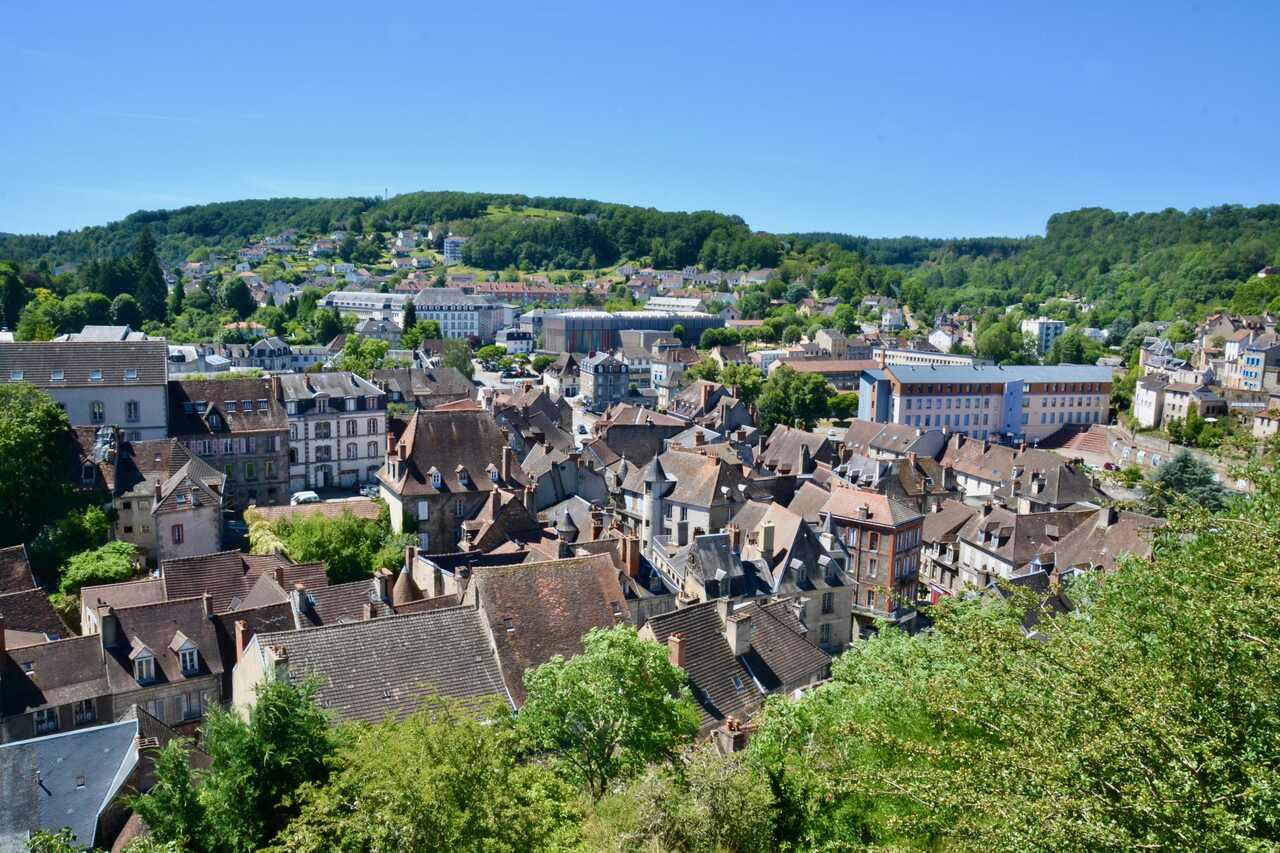

The most interesting work still happening in a French town of three thousand is done facing the wrong way.
I have not been to Aubusson. I’ve been reading the town’s own account of the craft, the UNESCO file from 2009, and the Cité internationale de la tapisserie’s notes on weaving and finishing, and I keep stopping at the same mechanical fact. The weaver sits at a horizontal loom and looks at the back of the image. A mirror goes between the warp threads when a check is needed. The face of the hanging is a rumour until the day they cut it free.
That day has a name.
The tombée de métier, the falling-from-the-loom, is the cutting of the warp. The town’s French is exact: it lets you see the hanging sur l’endroit, on the right side, for the first time. The Cité says the piece keeps its mystery for the whole of the weaving, and that the lissier, the weaver, and the artist both discover the work in its entirety only then. Two signatures go on it. I would go for that room. I would go for a town of granite houses in a bend of the Creuse that has been emptying since the mid-1970s and still runs this.
The reverse of the image
Aubusson tapestry, in the UNESCO wording, is the craft of weaving an image by processes practised in Aubusson and a number of other localities in the Creuse. Wall hangings, mostly. Also rugs and pieces of furniture. Any artistic style, provided it has been prepared as a carton, a full-size cartoon on paper or canvas, inverted, in the final format, painted in oil or gouache or marked with numbered colours. The inversion is the tell. You are not looking at the picture you will hang. You are looking at its opposite, and then you weave the opposite of that.
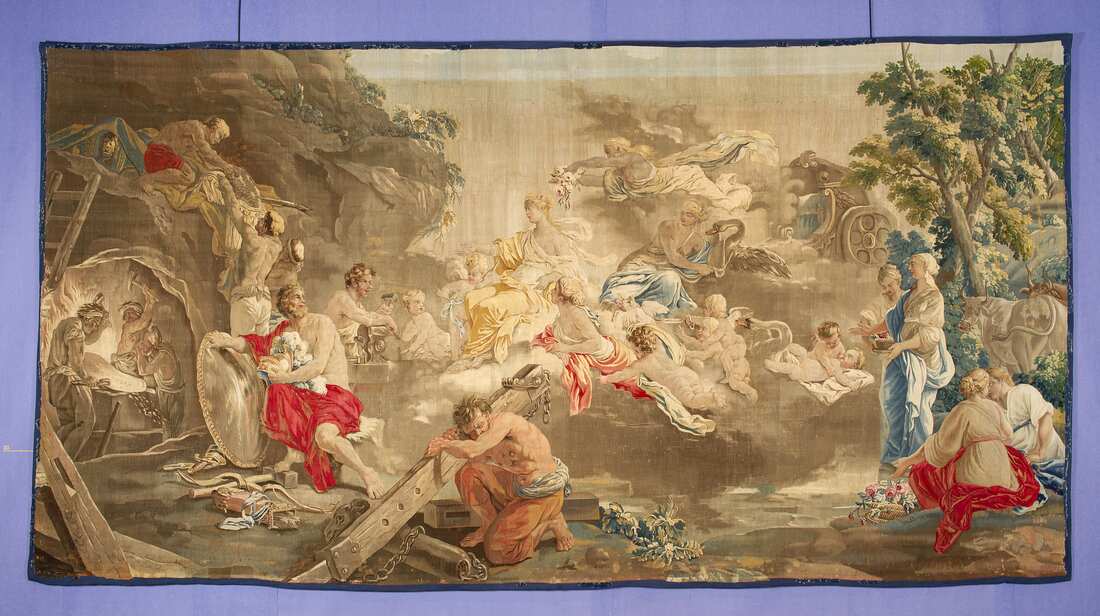

The loom is basse-lisse, low-warp, set horizontal. Cotton warp, the chain split even and odd. Each warp thread is tied by a lisse, a heddle, to a bar, and the bars to pedals, the marches. The weaver’s hand is full of flûtes, small wooden shuttles wound with wool, and with silk in historic pieces. Wool is seated with a grattoir and packed with a peigne. The warp disappears. As the work advances it rolls onto an ensouple, a beam, which is why the check is always partial. You cannot unfurl what you have already buried.
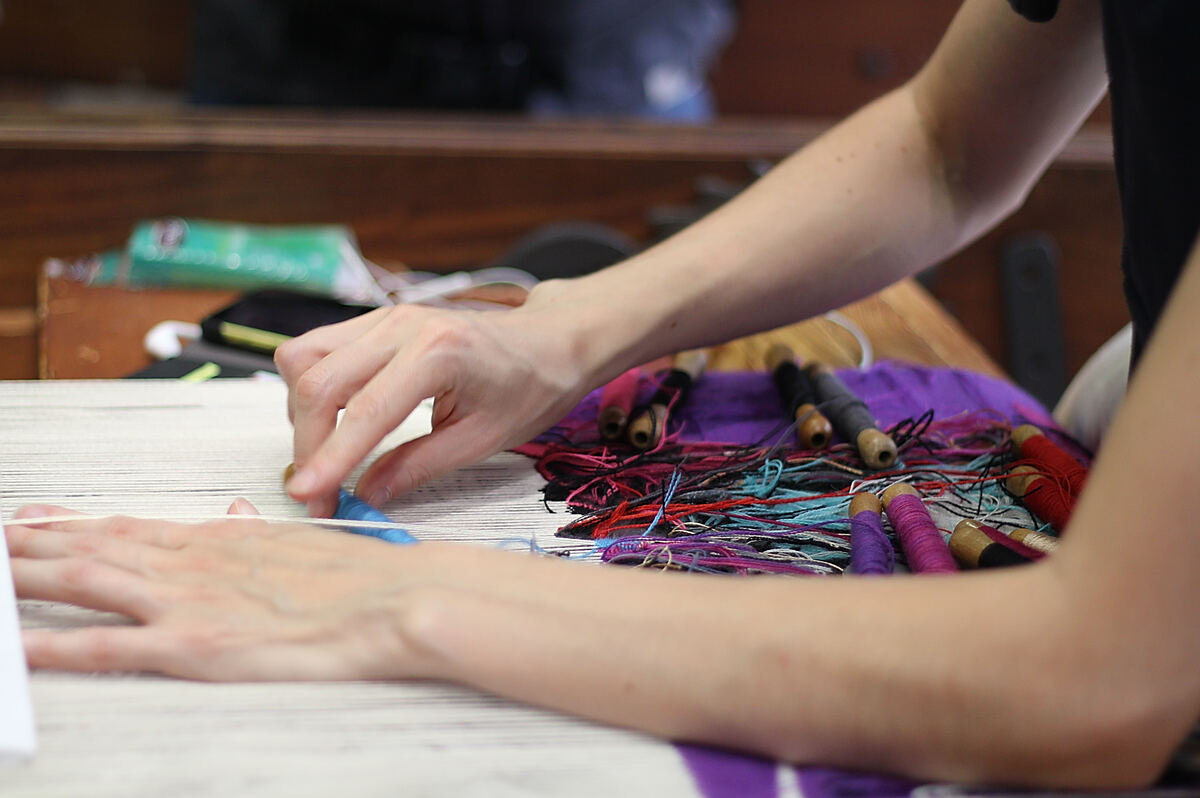

I keep thinking about the mirror. It is a small, slightly comic object in a process this slow. You part the cotton, you angle a glass at a cartoon that is already backwards, and you decide whether the red is the red you meant. Then you go back to the reverse. UNESCO calls the whole thing time-consuming and expensive, which is the sentence a committee writes when it does not want to say: this is a stupid way to make a picture, and that is why it is still a place.
I work in a world that previews everything. Draft, render, undo. The lissier has a mirror and a buried beam. I find that almost physically relieving to think about, which is probably a tell about my own habits, and I’m leaving it there.
The dyers work by eye. Primary colours added as powder. The Cité has both of those. The town’s process page puts the wool in the bath more than three hours at 95 degrees. A regional heritage inventory of a working Aubusson dyeworks, Thierry Roger and Nadia Petkovic, records successive baths at 80 degrees taking at least four hours. I’m not treating one published bath as the fact of the craft. The town says the Creuse’s water is reputed particularly pure, and that the wool is washed in it. I have no way to test the purity claim from here.
Felletin is in the file. UNESCO treats Aubusson and Felletin together. Written mentions from the 1450s at Felletin, 1457 in the town’s account. The Cité says only mid-15th century, at Felletin. The origin stories the town lists are flagged as obscure: a Saracen legend after 732, George Sand’s hypothesis about Zizim and Turkish weavers, Flemish alliances in the fourteenth and fifteenth centuries. I’m not picking a founder. The 1450s are the years that behave like years.
UNESCO’s 2009 inscription already located the craft in the Creuse. The Cité treats that file as defining an exclusive Creuse area. The legal perimeter is later: the 2018 INPI geographical indications, Tapisserie d’Aubusson / Tapis d’Aubusson, covering the department, with Certipaq and the grouping LAINAMAC in the chain. That is the opposite of a folk memory. It is a legal line around a department a lot of people drive through on the way to a city with a better train.
The town’s process page winds the flûte with gold. The arrondissement has fifteen people per square kilometre.
A town in a bend, emptying
The commune sat at 3,036 people in 2022, per INSEE. In 1968 it was 5,934. Then it rose to 6,227 in 1975, and from that peak the decline has been uninterrupted (3,018 in 2023). Density inside the commune is about 158 per square kilometre. The arrondissement around it, still named for the town, had 42,909 people in 2023, at 15.2 per square kilometre. That second figure is the one I keep on the desk. Fifteen people per square kilometre is not a mood. It is a count of who left.
Elevation between about 416 and 608 metres. Confluence of the Creuse and the Beauze. Granite houses. I have not stood on that stone. I have the numbers, the confluence, and a photograph habit I am trying not to substitute for having been there. The line that got this place onto the wishlist was a town folded into a river bend, emptying, still weaving from the back. The emptying is the other half of why I would go. A craft this slow in a dense city is a workshop you visit between lunch and a train. The same craft in a basin that has been losing its people since that 1975 peak is a decision someone keeps making.
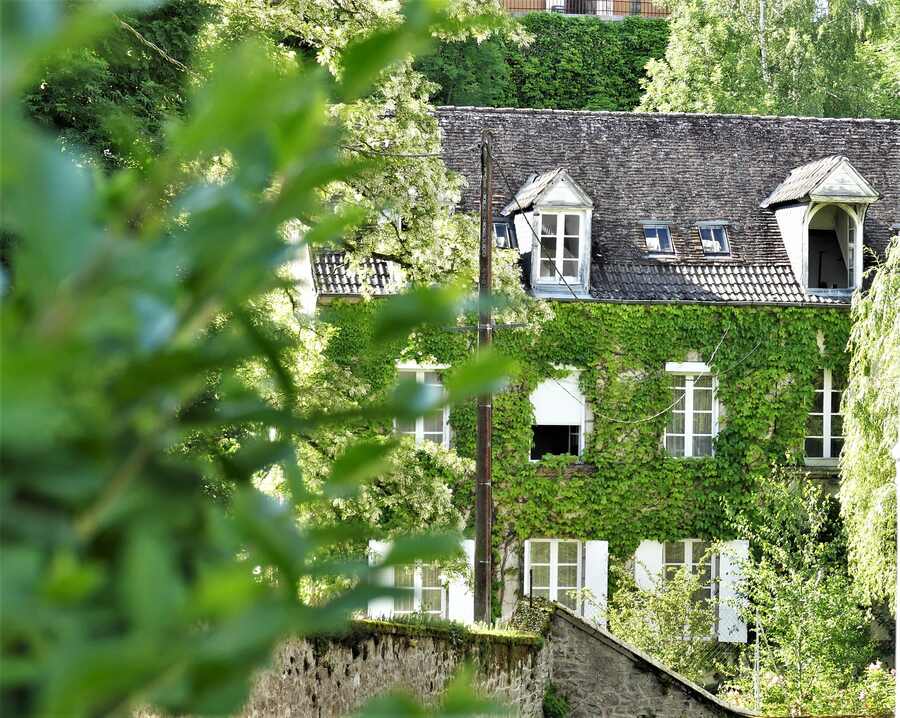

The Cité opened in 2016 in the former École nationale d’art décoratif d’Aubusson. The Ministry of Culture, marking ten years in 2026, puts attendance at about 50,000 a year since 2023. I’m using that figure once, and only because it sits next to the 3,036. A building in a small commune can draw that many people and the hills around it can still be empty. The visitors come for an institution. The institution exists because the reverse of the cloth is still being worked in the basin.
I’m not going to walk the Cité on the page. It is the living public face of a craft that used to live entirely in ateliers, and that is enough. Manufacture visits, a museum of cartoons, the Maison du Tapissier: the town lists them. I’m leaving the floor plan alone. I did not come to the file for a museum.
The count that won’t sit still
How many people still weave.
UNESCO in 2009, decision 4.COM 13.39, file 00250, said the production in Aubusson and Felletin provided enough work for three small businesses and ten or so freelance artisan weavers. That is a dated count. I’m not going to refresh it by force. The town’s own site, more recently, says about fifteen workshops, une quinzaine d’ateliers, still carry the savoir-faire across the Aubusson-Felletin basin. A 2026 piece in The Art Newspaper describes a larger filière, a whole supply chain. Those are three different ways of counting, from three different years, and they do not collapse into one number. The honest sentence is: fewer than there were, more than a heritage plaque, and the figure moves depending on whether you are counting businesses, looms, or the people around the looms.
I like that the numbers refuse to behave. A town this size, with a craft this slow, should not still be arguing with itself about how many ateliers it has. The argument is evidence. If it were over, the file would be a museum caption.
What I cannot do from here is tell you what a working atelier smells like at the dye bath, or whether the stone holds the day’s heat, or how loud the Creuse is under the town. Those are visit facts. I have the ensouple and the powder. The 15.2 is on the desk. I have a weaver who signs a picture they have not seen.
When I go, I want the tombée. I have not found a public rule that says a stranger may watch the warp being cut. The Cité describes the moment. The town names it. I’m not going to invent an invitation.
The facts
Aubusson is a commune in the Creuse, at the confluence of the Creuse and the Beauze. About three thousand people (INSEE, 2022: 3,036). Elevation roughly 416 to 608 metres. Felletin is the sibling town; UNESCO treats the two as one craft basin.
Nearest gateway: the departmental tourism body names Limoges-Bellegarde (LIG) for the plane. Clermont-Ferrand (CFE) is an equally used road and bus gateway, about an hour and a half by car, with an official bus line between Aubusson and Clermont. I do not have train times I trust, so I’m not writing any.
When to go: I don’t have a seasonal case from the official sources I read. The ateliers are described in the present tense.
The access rule that matters is geographic. UNESCO located the craft in the Creuse in 2009; the legal indication, in 2018, covers the department. If you go for the weaving, Felletin is not a detour. It is the other half of the name.
Sources
- Photo: Lucas Destrem, CC BY-SA 4.0 · img/hero.jpg
- Photo: Cité internationale de la tapisserie, CC BY-SA 3.0 · img/venus-aux-forges.jpg
- Photo: Nicolas Fressengeas, CC BY-SA 4.0 · img/basse-lisse-loom.jpg
- Photo: Père Igor, CC BY-SA 4.0 · img/manufacture-castel.jpg
- https://ich.unesco.org/en/RL/aubusson-tapestry-00250
- https://www.cite-tapisserie.fr/en/les-savoir-faire/les-savoir-faire-de-la-tapisserie-d-aubusson/tissage-et-finitions
- https://www.aubusson.fr/le-savoir-faire-de-la-tapisserie/
- https://www.connaissancedesarts.com/metiers_art/savoir-faire/ringarde-la-tapisserie-la-spectaculaire-renaissance-dun-art-poussiereux-devenu-tendance-11206775/
- https://base-indications-geographiques.inpi.fr/sites/default/files/CDC%20Tapisserie%20modifi%C3%A9%20complet%2022%20d%C3%A9c%202021.pdf
- https://www.cite-tapisserie.fr/les-savoir-faire/les-savoir-faire-de-la-tapisserie-d-aubusson/tissage-et-finitions
- https://fr.wikipedia.org/wiki/Tapisserie_d%27Aubusson
- https://ich.unesco.org/en/decisions/4.COM/13.39
- https://ich.unesco.org/fr/RL/la-tapisserie-daubusson-00250
- https://www.cite-tapisserie.fr/en/les-savoir-faire/les-savoir-faire-de-la-tapisserie-d-aubusson
- https://www.cite-tapisserie.fr/en/les-savoir-faire/les-savoir-faire-de-la-tapisserie-d-aubusson/cartons-et-teintures
- https://creuse-grand-sud.fr/vsc/vsc-2017-07-08.pdf
- https://www.cite-tapisserie.fr/en/les-savoir-faire/les-savoir-faire-de-la-tapisserie-d-aubusson/matieres-premieres-et-filatures
- https://ich.unesco.org/es/RL/la-tapiceria-de-aubusson-00250
- https://www.patrimoine-nouvelle-aquitaine.fr/default/doc/Dossier/6a061a0d-f732-4c64-878f-feb2d49fcb24/maison-puis-atelier-de-teinturerie-gabert-puis-nivet-puis-roger
- https://www.cite-tapisserie.fr/en/le-musee/nos-collections/6-siecles-d-histoire
- https://www.persee.fr/doc/anami_0003-4398_1895_num_7_26_6643
- https://www.cite-tapisserie.fr/en/les-savoir-faire/les-savoir-faire-de-la-tapisserie-d-aubusson/un-patrimoine-inscrit-a-l-unesco-depuis-2009
- https://www.inpi.fr/espace-presse/linpi-homologue-les-indications-geographiques-tapis-daubusson-et-tapisserie-daubusson
- https://www.legifrance.gouv.fr/jorf/id/JORFTEXT000037769142
- https://base-indications-geographiques.inpi.fr/fr/detail-ig/tapisserie-daubusson-IG18-002
- https://base-indications-geographiques.inpi.fr/sites/default/files/cdc_ig_tapisserie_Aubusson%20homologation_0.pdf
- https://www.insee.fr/fr/statistiques/8581709?geo=COM-23008
- https://www.insee.fr/fr/statistiques/1405599?geo=COM-23008
- https://en.wikipedia.org/wiki/Aubusson,_Creuse
- https://www.insee.fr/fr/statistiques/1405599?geo=ARR-231
- https://www.insee.fr/fr/metadonnees/geographie/commune/23008-aubusson
- https://www.citypopulation.de/en/france/admin/creuse/231__aubusson/
- https://www.annuaire-mairie.fr/ville-aubusson-23.html
- https://www.routard.com/fr/mag/reportage/a/pays-d-aubusson-la-creuse-entre-nature-et-unesco
- https://www.culture.gouv.fr/regions/drac-nouvelle-aquitaine/patrimoines-et-architecture-a-la-drac-nouvelle-aquitaine/la-cite-internationale-de-la-tapisserie-d-aubusson-celebre-ses-dix-ans
- https://www.cite-tapisserie.fr/files/e325456e/dp_2026_10_ans_cite_internationale_de_la_tapisserie_aubusson_web_vd.pdf
- https://fr.wikipedia.org/wiki/Cit%C3%A9_internationale_de_la_tapisserie
- https://www.tourisme-creuse.com/aubusson-felletin/decouvrir/tapisserie-savoir-faire-lainiers/
- https://www.artnewspaper.fr/2026/05/29/aubusson-retrouve-sa-place-de-capitale-de-lart-tisse
- https://fr.wikipedia.org/wiki/L%27Imaginaire_de_Hayao_Miyazaki_en_tapisserie_d%27Aubusson
- https://ig-aubusson.com/
- https://www.tourisme-creuse.com/en/aubusson-felletin/useful/getting-to-us/
- https://www.tourisme-creuse.com/offres/gare-routiere-daubusson-aubusson-fr-6297893/
- https://www.tourisme-creuse.com/app/uploads/tourisme-creuse/2024/05/Dossier-de-presse-2024-Anglais.pdf