Kunisaki Peninsula, Japan: the peninsula you walk


On Kunisaki, in northern Ōita, the temples only make sense if you walk between them.
I have not walked it. I have been reading. The peninsula is almost a circle, a volcanic headland shoved into the Seto Inland Sea, with Mount Futago (両子山, Futago-san) at about 720 metres in the centre and valleys running downhill to the water. I cannot tell you what the forest smells like after rain, or whether the climb to the cliff Buddhas is as steep as the guides say. That is the cost of a desk. I am writing anyway, because the wanting has a shape now, and the shape is a path.
The note I left myself was shorter than it should have been. Stone Buddhas carved into a cliff you reach through cedar, then stairs. A wooden temple older than Kyoto’s fame, sitting in a rice field. You walk between them. That is the whole destination. The Kyoto line was sloppy even as I typed it. Kyoto became capital in 794. The hall I mean is late Heian, Kyushu’s oldest wooden building, an Amida hall named in the same breath as the Phoenix Hall at Byōdō-in. Rural, then. Not older-than-the-capital. I pictured rice because I wanted rice, and cedar because I wanted cedar. The photographs put the hall against trees. The pages say forest. I am leaving the paddies and the species in the wanting and out of the facts.
Parking-lot religion is a trip I already know how to take. Kunisaki was arranged for people who moved on foot along ridges, and I want that arrangement, even from a chair.
Six districts, full mountain
The culture has a name. Rokugō Manzan (六郷満山), “six districts, full mountain”: Tendai temples, mountain worship, and the Shinto of Usa Jingū at the base of the peninsula, braided so tightly that the braid is the point. Visit Oita and Usa City both treat this as a birthplace of shinbutsu-shūgō (神仏習合), the old mixing of kami and Buddha. You can read that as theology. On the ground it is supposed to look like a Shinto torii standing on Buddhist temple land, which is what the photographs of Futago-ji keep showing me, a gate that would be a category error anywhere the Meiji separation had fully won.
The founder is a problem I like. Ninmon (仁聞), or Ninmon Bosatsu, is said to have appeared in 718 and founded temples. Twenty-eight is the number the sober pages use. Older copy still repeats a legend of tens of thousands of statues; I am treating that count as legend, not inventory. Visit Oita notes a prevailing historian’s view that a monk named Ninmon did not actually exist, and one theory holds he is an incarnation of Hachiman of Usa Jingū. Usa Jingū is the head of the Hachiman shrines. The shrine itself says there are over 40,000 of those nationwide. I am leaving that figure in the tourism column until I see a count I trust. Rank I trust. Head shrine, base of the peninsula, the kami the mountain temples keep borrowing.
Once every ten years, give or take, the monks still do the thing the temples were built around. Mineiri (峰入り), “entering the mountain.” Visit Oita’s picture is a circuit that starts from Mount Omoto, stays on trackless ridgelines, does not drop into inhabited villages, and counts 65 sacred sites. Usa City’s pilgrimage page is another picture: assemble on Mount Omoto, a goma fire at Usa Jingū, another goma the next morning in front of the Kumano cliff Buddhas, then a route of more than 160 kilometres and 180-odd sacred spots. I am not going to mash 65 and 180-odd into one number, and I am not going to mash a ridgeline that never comes down with a rite that opens in the shrine town. Related, or counting different things, or both. What they agree on is the clock.
The last Edo circuit was in 1853. The rite was interrupted through the Meiji years and revived in the late 1950s. A revival is a scar. The peninsula kept the mixing in the architecture even when the state wanted the categories clean.
The cliff and the hall
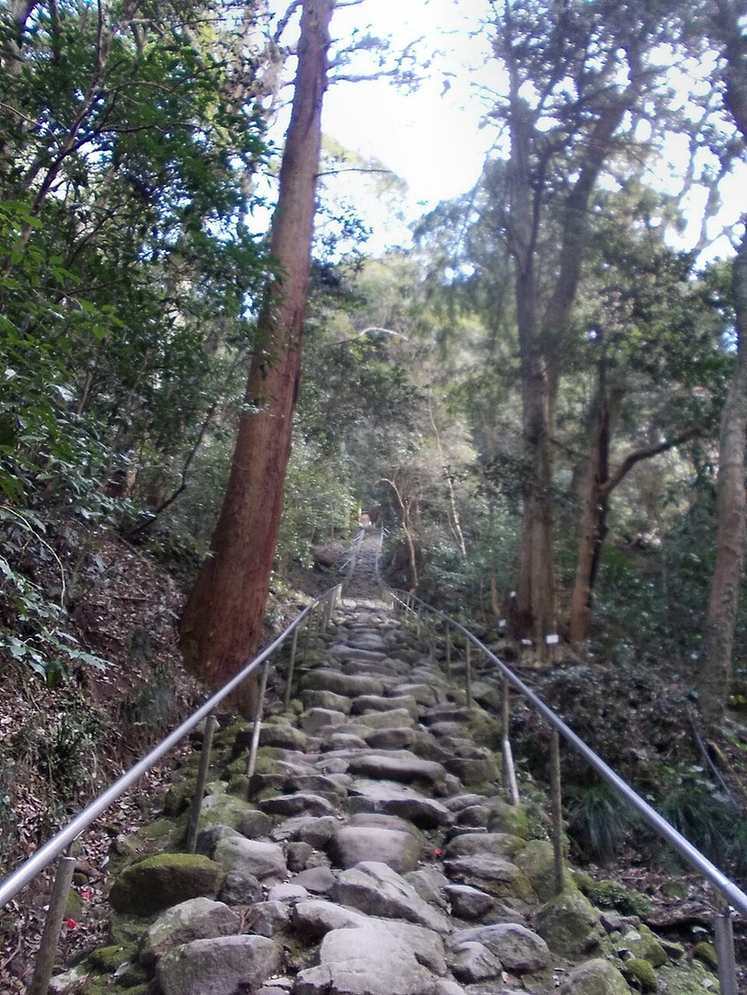
Kumano Magaibutsu (熊野磨崖仏), in Bungotakada, is the image I cannot stop opening. Magaibutsu (磨崖仏) are Buddhas carved from the living cliff, not set on it. Two of them. Nippon.com, working from the photographer Tomohiro Muda’s measurements, gives Fudō Myōō at 8.1 metres (early Kamakura) and Dainichi Nyorai at 6.8 metres (late Heian). Bungotakada’s own heritage card puts Fudō at 8.0. About 8 metres and about 6.8. They are an Important Cultural Property. You do not see them from a lot. The approach is a forest walk of about ten to thirty minutes, then a steep flight of stairs. Other copy mentions 99 stone steps from a torii, built in one night by a demon. I will take the stairs as real and the demon as a story.
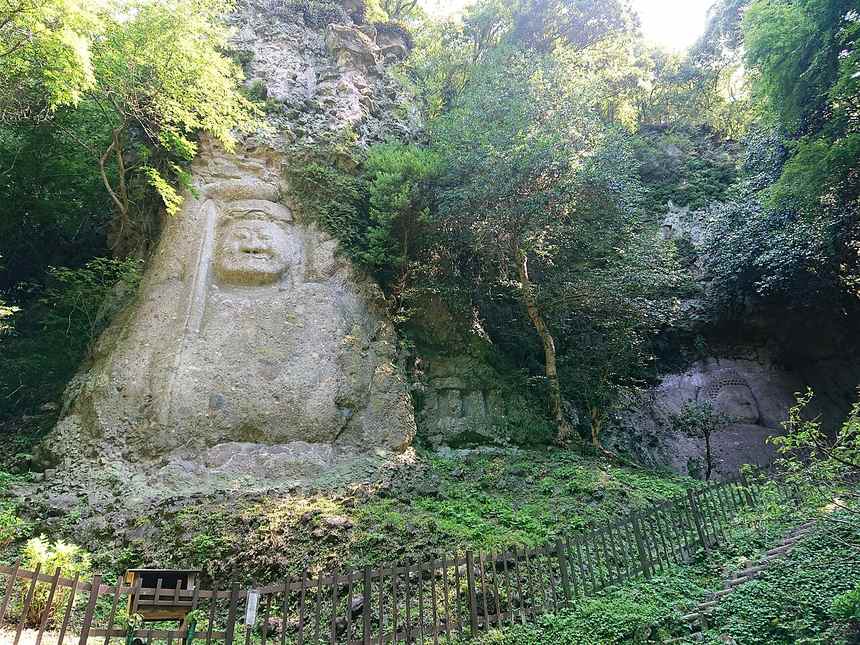

That walk is the argument. If you could park at the foot of the faces, they would still be large. They would not be the same visit. I want that walk. Forest, then stairs, arriving already a little tired, which is an unfashionable way to look at stone, and the one this peninsula seems to have been designed for.

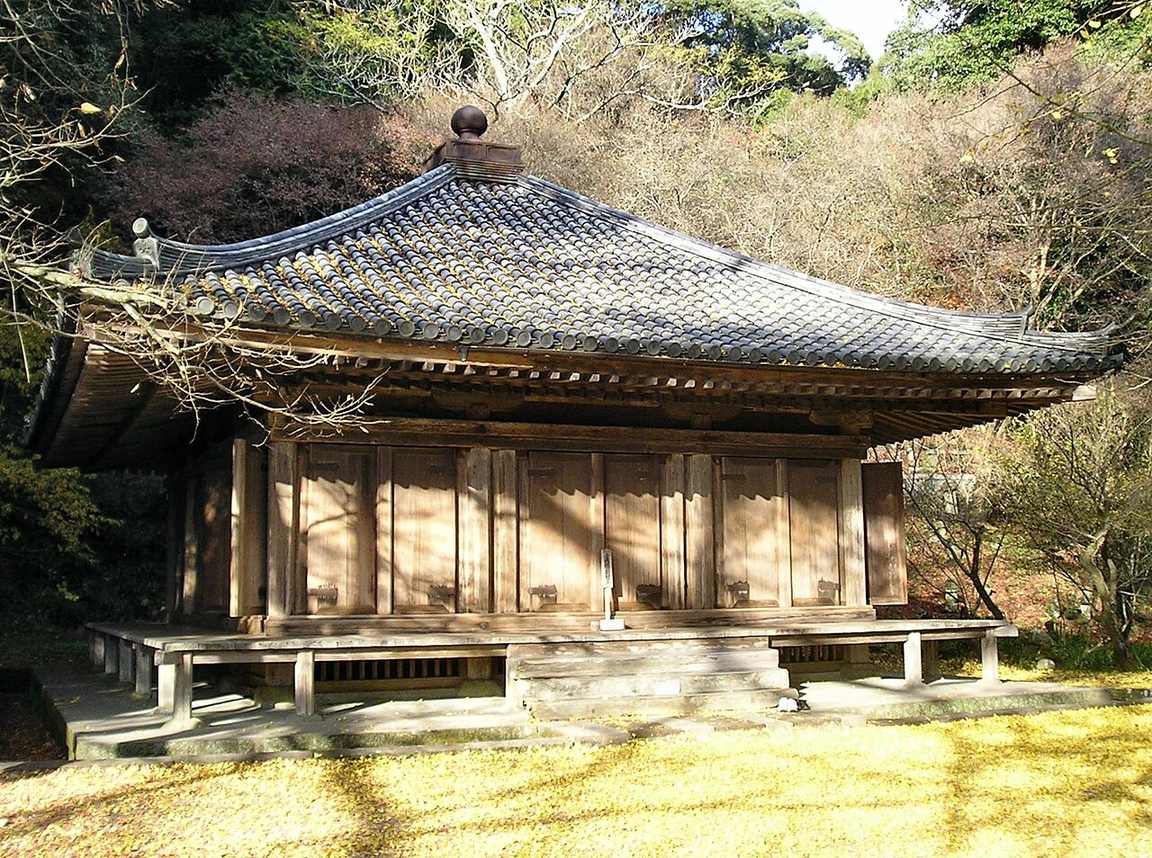
Fuki-ji (富貴寺), also Bungotakada, sometimes written Fukiji, is the wooden counterweight. The main hall, the Ōdō, is a National Treasure, the oldest wooden building in Kyushu, dedicated to Amida. Japan-guide dates it late Heian (the span 794 to 1185) and ranks it among the three great Amida halls, with the Hōōdō at Byōdō-in and the Konjikidō at Chūson-ji. Visit Oita believes the temple was founded in the tenth to twelfth centuries, which sits poorly next to the 718 Ninmon legend. Founding stories and standing timber are different clocks. I am going with the timber.
A hall like that in Uji or Hiraizumi has a capital, or a court, leaning on it. This one sits in a quiet rural valley with trees behind it. That is the comparison I should have written in the note. Same rank of hall. Different kind of silence, if the photographs are even half honest. I have not stood in it. I keep looking at the roof line anyway.
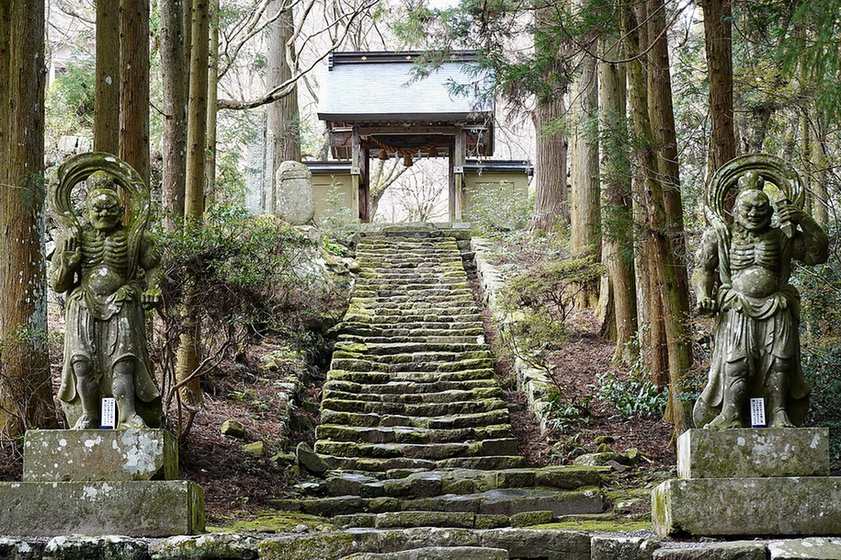
Futago-ji (両子寺) is the mountain’s own temple, on the forested slopes of Futago-san, called the centre of Rokugō Manzan and said to have been founded in 718. Japan-guide puts more than 1,300 years on it, which is the legend wearing a number. The traditional approach starts at a pair of stone Niō, about 2.5 metres high. Ōita Heritage dates them to 1814 and calls them the most imposing on the peninsula. Then a short climb. There is a Gomadō for Fudō Myōō, and further on an Okunoin with a thousand-armed Kannon. The torii on the temple ground is the shinbutsu-shūgō sentence made in wood: a Shinto gate where a Buddhist temple is supposed to be. I want that more than I want another perfectly sorted precinct.

Maki Ōdō (真木大堂) is a side door I will probably miss if I ever get the days wrong. Treasure house of wooden images. Amida, the Four Heavenly Kings, Fudō. City tourism says the original hall burned about seven hundred years ago. The statues survived. They sit in the treasure house now.
The circuit and the trail
Portions of the old training route are open to walkers as the Kunisaki Peninsula Minemichi Long Trail (国東半島峯道ロングトレイル). Minemichi (峯道) is the mountain path. Bungotakada city trail copy says about 135 kilometres, from the Kumano Magaibutsu toward Futago-ji. Other trail copy comes in shorter. I am not picking a length. Oita tourism warns of cliffs and slippery sections and talks about mountaineering equipment, which is the opposite of a temple-stroll sentence. Japan-guide says public transport is poor and a rental car is the practical way between sites. I believe the guides. I still want sections of the trail, not a loop of lots.
The monks’ mineiri is not the long trail. I am not a monk, and I am not going to pretend a week of day-hikes is a decennial rite. The trail is a path a visitor can actually be on, related by blood and not the same walk. I want the weekday version: a cliff, a hall, a mountain temple with a torii on it, and enough distance between them that the car stays a tool I resent.
I have spent too many evenings on photographs of temples with a coach park in the foreground. Kunisaki keeps failing to look like that, which is why it is still on the list.
When I go, I want the first morning to be the forest walk to the magaibutsu, before I have seen the Ōdō. Climb, then wood. I have a feeling I will get the order wrong. The next mineiri will happen on a roughly ten-year clock I cannot set. I will not be on it. I would like, at least, to be on the path that remembers it.
Kunisaki Peninsula, northern Ōita Prefecture, Kyushu. The nearest airport is Oita (OIT), on reclaimed land in Kunisaki city. Bungotakada city trail copy puts the Minemichi long trail at about 135 kilometres; other maps come in shorter. Prefectural copy warns of cliffs and slippery sections; the guides say public transport is thin. Fuki-ji, the Kumano Magaibutsu, and Futago-ji currently list daytime hours and modest entry fees, on the order of 300 to 500 yen, with slightly shorter winter light at the cliff. Check Bungotakada city and futagoji.jp before you go. I have not tested any of this on the ground.
Sources
- Photo: STA3816, CC BY-SA 3.0 · img/hero.jpg
- Photo: Hajime NAKANO, CC BY 2.0 · img/kumano-magaibutsu.jpg
- Photo: STA3816, CC BY-SA 4.0 · img/kumano-stairs.jpg
- Photo: Bruno Rijsman, CC BY-SA 2.0 · img/futagoji-nio.jpg
- https://en.wikipedia.org/wiki/Kunisaki_Peninsula
- https://oitaisan.com/english/heritage/the-history-and-landscape-of-the-mountains-of-kunisaki-peninsula/
- https://oita-tourism.com/en/stories/detail_75.html
- https://www.jstage.jst.go.jp/article/kazan/61/1/61_KJ00010257776/_pdf
- https://en.wikipedia.org/wiki/Heian-ky%C5%8D
- https://www.nippon.com/en/japan-topics/g00993/
- https://www.worldhistory.org/Heiankyo/
- https://www.japan-guide.com/e/e4724.html
- https://ja.wikipedia.org/wiki/%E5%85%AD%E9%83%B7%E6%BA%80%E5%B1%B1
- https://www.city.kunisaki.oita.jp/site/kanko/yumekikou-satori.html
- https://www.city.usa.oita.jp/tourist/selectlanguage/English/touristspotenglish/13569.html
- https://en.wikipedia.org/wiki/Usa_Jing%C5%AB
- https://en.wikipedia.org/wiki/Futago-ji
- https://sacrednaturalsites-japan.net/kunisaki/
- https://www.city.usa.oita.jp/sougo/soshiki/14/toshikeikaku/keikan/matidukuri/usachiku/sinbutusyugou/12744.html
- http://japanesewiki.com/person/Ninmon.html
- https://en.wikipedia.org/wiki/Hachiman_shrine
- http://www.city.usa.oita.jp/sougo/soshiki/14/toshikeikaku/keikan/matidukuri/shinbutsushugosyncreticworship/RitualsandFestivalsatUsaJinguShrine/15459.html
- https://visit-kunisaki.com/en/our-history/
- https://www.city.bungotakada.oita.jp/site/showanomachi/1248.html
- https://en.wikipedia.org/wiki/Kumano_Magaibutsu
- https://www.nippon.com/en/japan-topics/b10934/
- https://japan-heritage.bunka.go.jp/ja/culturalproperties/result/3990/
- https://oita-tourism.com/en/attractions/detail_1050.html
- https://www.city.bungotakada.oita.jp/site/showanomachi/1251.html
- https://online.bunka.go.jp/heritages/detail/124404
- https://www.japan.travel/en/spot/692/
- https://www.mlit.go.jp/tagengo-db/H30-01235.html
- https://oita-tourism.com/en/attractions/detail_1071.html
- https://oitaisan.com/english/heritage/futago-ji-temple-statue-of-niou-and-temple-gate/
- https://www.japan.travel/japan-heritage/popular/ccc2d69d-df80-4012-95e2-4ee07bb68d30
- https://visit-kunisaki.com/spot/%e4%b8%a1%e5%ad%90%e5%af%ba/
- https://www.gltjp.com/en/directory/item/12825/
- https://www.city.bungotakada.oita.jp/site/showanomachi/1249.html
- http://www.makiodo.jp/hall.html
- https://www.city.bungotakada.oita.jp/site/showanomachi/1948.html
- https://www.city.kunisaki.oita.jp/uploaded/attachment/9208.pdf
- https://oita-tourism.com/en/stories/trekking
- https://www.yamakei-online.com/yk/issue/japantrail2025/c23.php
- https://en.wikipedia.org/wiki/Oita_Airport
- https://www.oita-airport.jp/about/
- https://web.archive.org/web/20171003225141/http:/www.ocab.mlit.go.jp/about/jurisdiction/oita/