Higashiyama, Kyoto: a week of quiet mornings off the tourist route

The fountain in the garden runs all night, and on the first night it’s the only thing that convinces me I’m anywhere at all. I land at Kansai in the late afternoon, ride the Haruka a little over an hour through suburban grey-green, and arrive in Higashiyama with no memory of what day it is. Akiko, the machiya’s host, meets me at a door down a street so narrow the taxi can barely turn into it. She bows, hands me the keys, explains the trash sorting. I absorb maybe half of it. I drop my bags, walk one block to see the Yasaka Pagoda go black against a fading sky, come back, and sleep at four in the afternoon like someone switched me off.
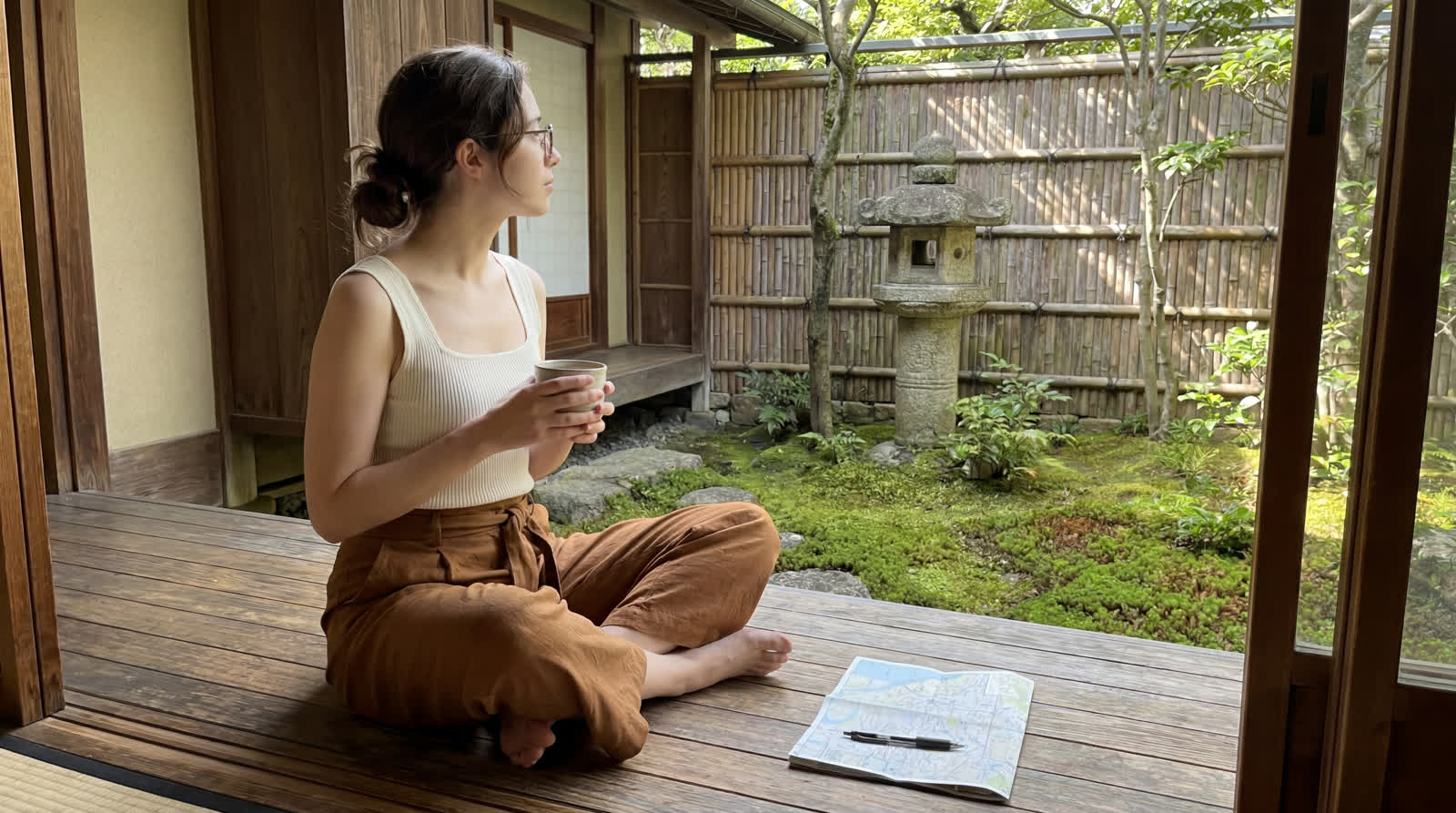
I wake at midnight. Fully, hopelessly awake. I sit on the engawa, the wooden veranda that edges the inner garden, and listen to the stone fountain tick water into itself in the dark. The house is over a hundred years old. The tatami smells like dried grass. It’s too quiet, and I don’t know yet how to be in it.
That’s the thing this week teaches me, slowly, one morning at a time: how to be in the quiet. I came thinking the trip would be temples. It turns out to be mornings.
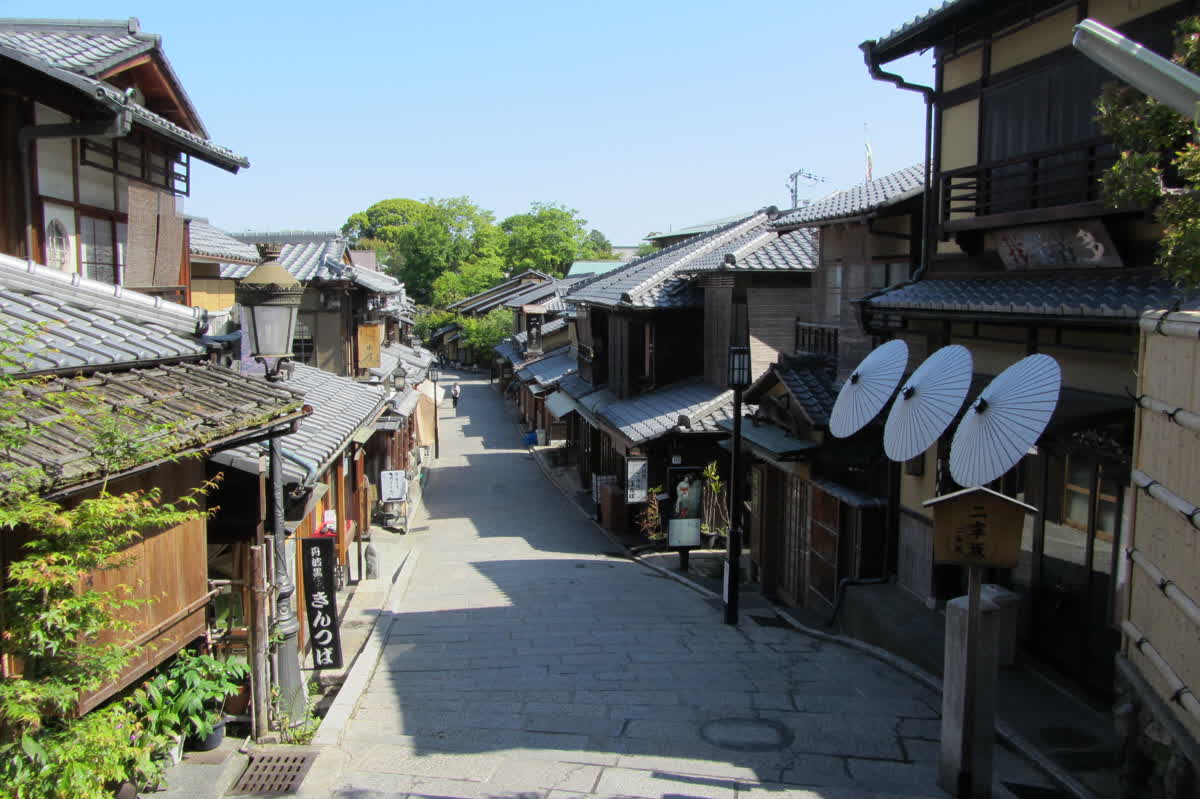
The second one starts at three. I give up on the futon, read for a while, and go out at four-thirty into a Higashiyama that belongs to no one. The blue hour sits on the old wooden storefronts and nothing moves. I walk up the slope toward the pagoda and it’s lit against the indigo, and I stand there ten full minutes without seeing another person. Down by the Kamo River there’s a heron in the shallows under the Sanjo bridge, holding so still it could be a decoration someone set there and forgot. I eat a beef bowl at a 24-hour Matsuya because I can’t remember my last real meal. It’s salty and hot and exactly right. Then I go back to the house and write until dinner, and the silence of the place gets into the prose without my asking it to.

By the third day I finally land. I learn this the way you learn most true things, which is in a small room over a cup of coffee.
Fuku Coffee Roastery is down one of those side streets where you’re not sure you’re allowed to walk until someone comes the other way and you both nod. The owner roasts in a space barely bigger than a closet. There are four seats. I order a pour-over of something from Nara and he makes it with a slow, deliberate care that makes me forget my phone is in my pocket. I sit at the counter and watch him work three more orders the same way. No rush. No performance for the room. A cat sleeps on the step outside the open door, and the whole place smells like the inside of a good idea. I don’t take a single useful photograph of any of it, which I’ll regret, and which is also fine.
The garden teaches the same lesson the next morning, earlier. I wake before dawn and for once I haven’t slept through the best hour. The ferns at the base of the stone lantern still hold their dew. The moss has the deep, saturated green that only lasts sixty minutes or so. I make a plain sencha from the packet Akiko left, sit on the edge of the engawa with my bare feet on the cold old wood, and don’t move for a long time. The maple throws fine, shifting patterns on the far wall as the light comes up. The garden is barely wider than my arms are long, and I keep turning over how a space that small can hold this much stillness. It isn’t empty quiet. It’s held quiet. There’s a difference, and Kyoto keeps showing it to me.
I’d meant to go to Giō-ji that day. A couple I met at an izakaya near Yasaka Shrine, Kenji and Yumi, wrote the name on a napkin for me. He’s an architect, she teaches piano, they come up from Osaka on weekends, and Yumi told me the late-afternoon light at that moss garden is the most beautiful thing in Kyoto. The napkin sits by the futon all week. I never make it. Three mornings running I step outside meaning to catch the bus, and three mornings running the day takes me somewhere else instead.
The day it takes me to SWAY, I’ve made a wrong turn. Coming down the back of Kiyomizu through the cemetery, past weathered markers with fresh flowers at their feet, I lose the path and end up on a residential street with laundry strung between the buildings and a cat watching me from a second-floor window with total indifference. This is the geography of Higashiyama: the tourist route and the actual neighborhood run about thirty meters apart, and once you step off the paved part you’re in someone’s ordinary Tuesday. SWAY is in that ordinary Tuesday, a roastery in a concrete building with a wood-and-glass front you’d pass without a glance if the door weren’t open and the smell weren’t already on the sidewalk. Five stools. A young, quiet barista moving a kettle in slow spirals over the V60. He holds up two bags of beans and points between them, I point at the darker one, he nods like I’ve made a sensible call. It’s the best pour-over of the trip, maybe the best I’ve had anywhere. An older man reads a novel at the end of the counter and we sit there twenty minutes in a shared silence that asks nothing of either of us. I keep finding that specific ease here, the at-homeness of strangers not talking, and I haven’t found much of it anywhere else.
The kissaten morning is different again. By day five my body has surrendered to the timezone and I sleep past seven, which feels extravagant. Kissa Kishin isn’t a third-wave roastery. It’s the older thing: dark wood paneling, six counter seats, a barista hand-brewing each cup with the kind of unhurried care the room seems built for. I order the morning set. The toast is the point. It’s cut from a shokupan loaf two inches thick, grilled until the shell goes crisp and the inside stays a cloud, and it’s a category of toast that doesn’t exist where I’m from. I take the window seat and eat slowly and watch the street wake. A regular comes in, greets the barista by name, sits without ordering, and he just starts making her coffee. She catches my eye, gives me a small nod, and that’s the entire exchange, and it’s enough.
There are bigger places in between, and I won’t pretend I skip them. Kiyomizu-dera, twice, both times early enough to beat the crowds, the famous wooden stage standing fully exposed in the morning light, the hillside dropping away beneath it the way it has for centuries. Nanzen-ji and its Meiji-era brick aqueduct, the Suirokaku, Roman arches carrying water through a Zen forest, which has no business working and works completely. Ginkaku-ji and the hillside of moss behind it. But the temples aren’t where the week happens. The week happens on benches.
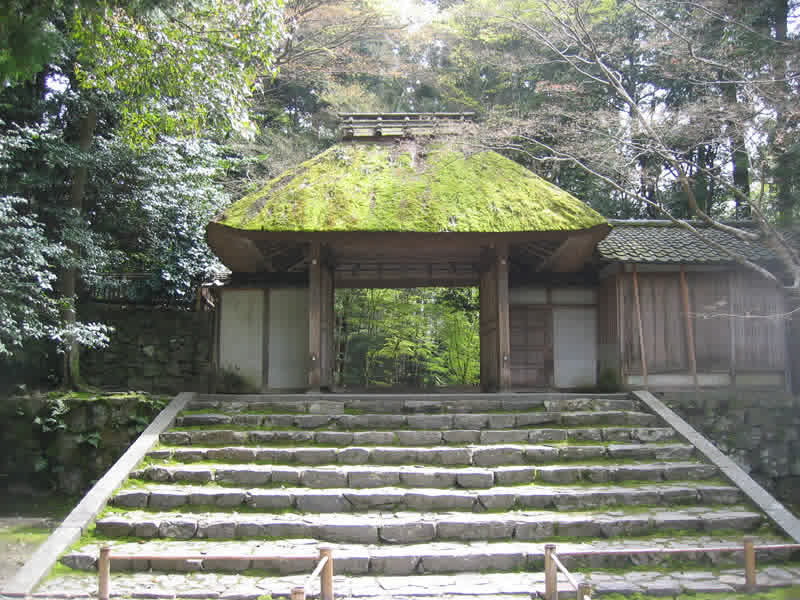

On day five it happens on a stone bench at Hōnen-in, a small temple hidden just off the Philosopher’s Path behind a thatched gate so low you almost have to bow to pass under it. Inside: moss on everything, two raised sand platforms raked into concentric circles, four other people in the whole complex. I’m sitting under a maple listening to a bird repeat the same phrase when a woman sits down at the other end of the bench. Late sixties, blue linen dress, walking shoes, a book and a small canvas bag. She tells me the bird is an uguisu, a bush warbler, and it’s late in the season for one to still be singing. When I say, in my careful classroom Japanese, that I’m glad it still is, she laughs and switches to English: “It doesn’t know its schedule.”
Her name is Sachiko. A retired librarian from Osaka, she comes to this exact spot twice a month and has for eleven years. We talk about Tanizaki and Kawabata and Yōko Ogawa, about how I ended up on her bench. When I tell her I’m traveling alone she says something I’ve been turning over since: “Solo travel is the only kind where you meet the place instead of performing it for someone.” She says it like a fact, not advice. Before she leaves she touches my shoulder and says, “Enjoy your stillness,” and walks back out through the low gate, and I understand I won’t see her again. Some people are a single scene that stays with you.
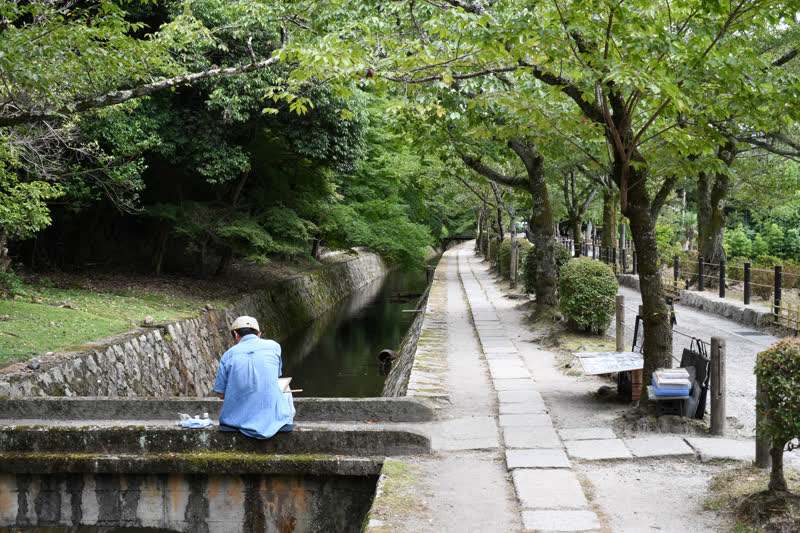

The same walk gives me the washi shop. Midway up the Philosopher’s Path, past a fat calico asleep on a bridge railing, there’s a tiny store that sells nothing but handmade paper. I spend twenty minutes among sheets that cost more than my lunch and buy three: one the color of persimmon, one pale celadon, one with real maple leaves pressed into the fibers. I have no idea what I’ll do with them. They fan out on the low table by the futon for the rest of the week, and that’s use enough.
Then it’s the last morning, and the mornings have done their work. I’m on the engawa with a cup of hojicha too hot to drink, watching the grey-green sharpen into real color, and the quiet has stopped being something I’m braced against. Yesterday I went back to the ceramics shop on Ninenzaka and finally bought the iron kettle I’d been talking myself out of for three days. It’s heavy. It belongs to a much slower version of time than the one I usually live in. I almost left it again, and then realized I didn’t want to leave this house without something that could hold its weight.
I leave on the eighth day with the door still warm from the sun. I pull it shut, hear the latch catch, and stand on the stone step a second longer than I need to, looking at the wood grain. Akiko told me the first night the house was over a hundred years old. I believed it then the way you believe any fact a host hands you. I believe it differently now.
On the bus to Kyoto Station I hold the kettle in my lap because I don’t trust the suitcase not to bang it around. The woman beside me glances at it, clearly weighing whether it’s a strange thing to carry on a city bus. It is. It’s wrapped in two layers of the shop’s brown paper and a towel I stole from the machiya’s bathroom closet, and it weighs almost nothing against the rest of my luggage and everything against the rest of the trip. When I get home and set it on my own stove and boil water in it the first time, I think something will cross over. The quiet of that house will live in the steam. That’s the idea, anyway. Maybe it’ll just be a kettle.
I don’t think so.
About Higashiyama
Higashiyama, Kyoto. A historic preservation district on the eastern hillside of central Kyoto, stretching from Kiyomizu-dera south to Gion and the Philosopher's Path north. Official site: Kyoto City tourism.
The photograph of August in this piece is AI-generated. Every other image above is a real photograph of Higashiyama and its surrounding temples, credited below.
Getting there
Flights to Kyoto (via KIX) · Places to stay in Kyoto
Some “getting there” links are affiliate. They don’t cost you anything, and they don’t change what I write about.
Sources
- Photo: David Wiley, CC BY 2.0 · img/honenin-gate.jpg
- Photo: Gzzz, CC BY 4.0 · img/philosophers-path.jpg
- Photo: Aporon999, CC BY-SA 3.0 · img/ninenzaka-street.jpg
- https://www.japan-guide.com/e/e2363.html
- https://www.jrailpass.com/blog/haruka-express-kansai-airport
- https://kyoto.travel/en/destinations/hokanji-templeyasaka-pagoda/
- https://en.wikipedia.org/wiki/Yasaka_Pagoda
- https://en.japantravel.com/kyoto/birdwatching-on-the-kamogawa/10616
- https://www.japannatureguides.com/wild-watch/grey-heron-master-of-japans-wetlands
- https://fuku-coffee-roastery-admin.myshopify.com/en
- https://tabelog.com/en/kyoto/A2601/A260301/26039606/
- https://www.instagram.com/sway_coffee_roastery/
- https://tabelog.com/en/kyoto/A2601/A260301/26044854/
- https://tabelog.com/en/kyoto/A2601/A260301/26038151/
- https://www.ninjafoodtours.com/best-breakfast-in-kyoto-2026-japanese-sets-morning-cafes/
- https://www.kiyomizudera.or.jp/en/news/2020/the-main-hall-is-under-renovation-work.php
- https://www.japan-guide.com/blog/schauwecker/200212.html
- https://biwakososui.city.kyoto.lg.jp/en/place/detail/32
- https://www.snowmonkeyresorts.com/activities/suirokaku-aqueduct/
- https://www.japan.travel/en/spot/1170/
- https://www.japan-guide.com/e/e3907.html
- https://www.discoverkyoto.com/places-go/honen/
- https://www.japan-experience.com/all-about-japan/kyoto/temples-and-shrines-in-japan/honen-in-temple-kyoto-a-serene-oasis-on-the-philosophers-path
- https://www.japan-guide.com/e/e3906.html
- https://www.jrailpass.com/blog/philosophers-walk
- https://www.japan-guide.com/e/e2345.html
- https://japn.com/gyudon-beef-bowl-guide/