Jebel Akhdar, Oman: the mountain that keeps time by water


Jebel Akhdar keeps a better clock than a wristwatch. The clock is a gravity ditch.
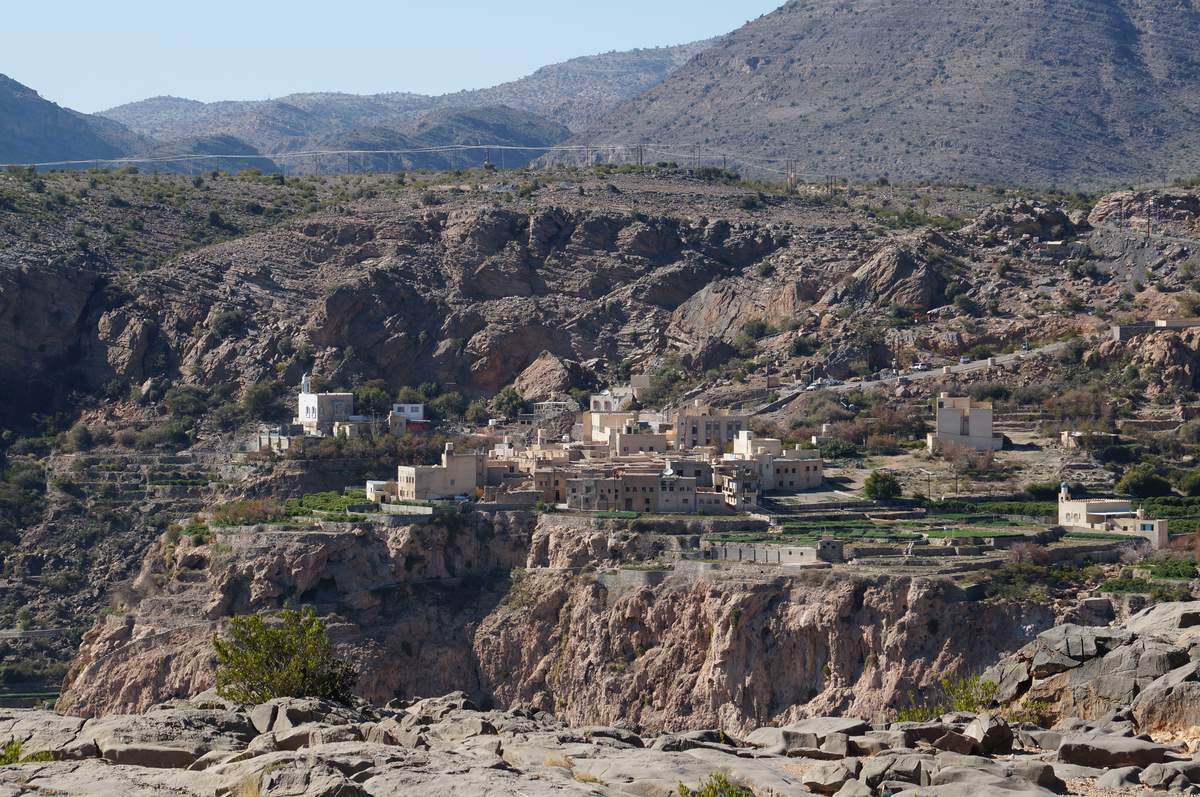
I have not been there. I’ve been reading about Al Jabal Al Akhdar, the Green Mountain in the Al Hajar range in Oman, for the better part of two weeks. The inhabited upland is the Saiq Plateau (also Saiq, Sayq, Seeq), about 2,000 m above sea level. Terraces at that height, irrigated by gravity. A plot drinks when its share of the channel arrives. I can’t tell you what the water sounds like in that channel at the hour that is theirs. I have papers and photographs. The sound isn’t in them.
The wanting has a path. I want to walk between Al Aqr and Al Ayn, with Ash Shirayjah on the same loop. The spellings wander (Al Aqer, Al Aqur, Al Aqar; Al Ain; Al Shirayjah, Al Sharijah, Al Shuraiga). I’m picking one set. The walk linking the three is real. The loop runs through abandoned houses and still-worked terraces. I have no founding century for the villages, and I’m not going to invent one so the sentence sounds older.
the share
A falaj (plural aflaj) is a gravity channel fed from groundwater or a spring. UNESCO also names a surface, wadi-fed type, the ghaili; on this mountain the relevant family is the spring-fed channel. Water runs downhill. In 2006 UNESCO inscribed five representative systems in Oman as the Aflaj Irrigation Systems of Oman, out of some 3,000 still in use. Origins may date to AD 500. Archaeology suggests irrigation in the area as early as 2500 BC. Those are different depths, and I keep wanting to collapse them into one impressive number. They shouldn’t collapse. Four of the five inscribed components cluster around the Al Jabal Al Akhdar range. The terrace channels at Al Ayn are of the same family. They aren’t the inscribed five.
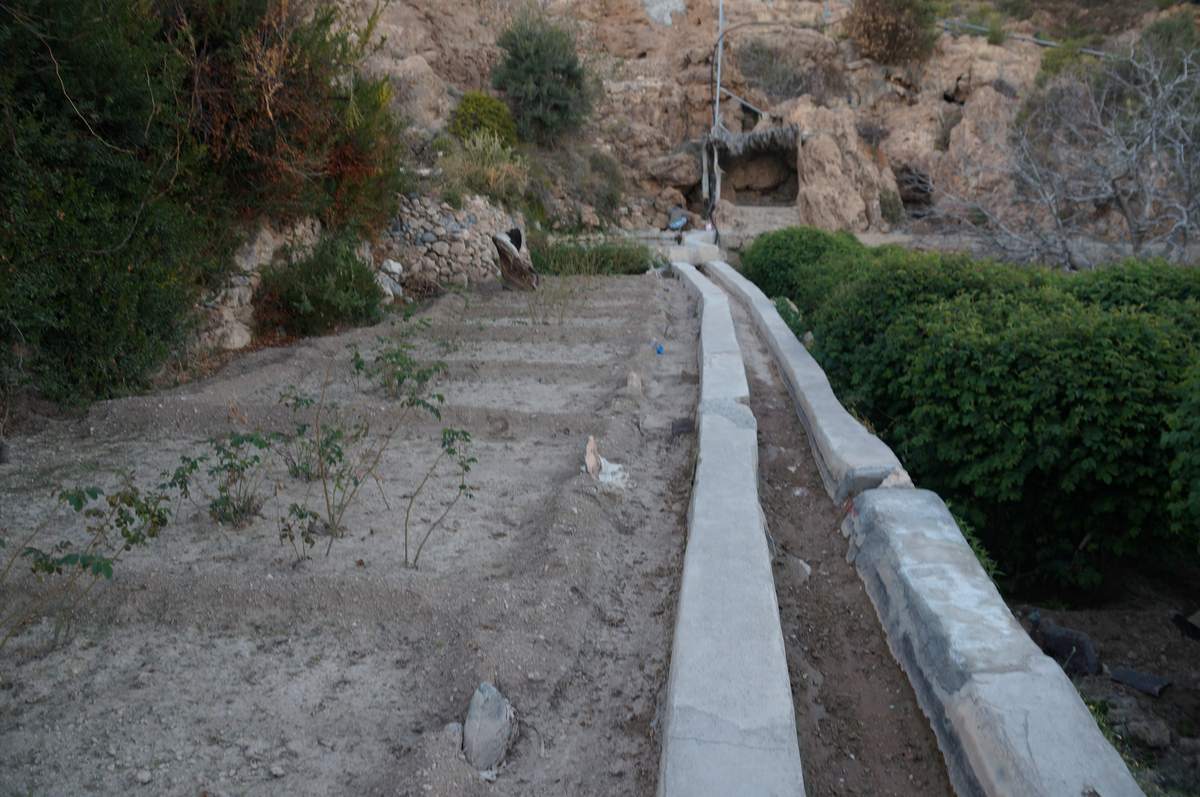

Water is divided on a time-share. The cycle is a dawrān, often seven to fourteen days, and it can run shorter or longer. A day splits into bādda, day and night. The common share unit is an athar, theoretically about thirty minutes, forty-eight of them in a day. Traditional timing used a sundial by day and stars by night. Al-Ghafri describes a water timer called a tasa, or sahlah, on this mountain (falaj Saiq). I haven’t found independent researchers who duplicate that device, and I won’t treat it as something still in daily use. I also won’t tell you every household still times its share by sundial in 2026. The system of shares is living. The instruments have modernised. Watches exist. The water still arrives on a turn.
Forty-eight slots in a day. A week or two before your slot comes around again. Those are the numbers I kept. A plot that drinks for thirty minutes in a cycle of days is a different relationship to waiting than a tap. You plan the garden around a delivery you don’t control. Miss it and you wait for the dawrān to come back around.
A phone can time an athar now. The share still has to be a share. Modernising the instrument doesn’t privatise the water. I like that stubbornness, and I like it from a distance, which is a suspicious place to like stubbornness from.
UNESCO puts it like this, and I’m quoting because the sentence is doing work I shouldn’t paraphrase into something prettier: the fair and effective management and sharing of water in villages and towns is still underpinned by mutual dependence and communal values and guided by astronomical observations. Mutual dependence is a scheduling problem with neighbours attached. Honest, here, means you can’t pretend the hour is only yours. Someone upstream already took theirs. Someone downstream is next. A wristwatch is a private object. A share in a falaj is a public one. This is the opinion I’ll defend: a public clock of this kind is more honest than a private one. You can disagree. Plenty of people would rather have a tap, and they wouldn’t be wrong about convenience.
The desert is below, doing none of this.
That sentence is the one that snagged me on a wishlist and wouldn’t come off. Terraces at 2,000 m above sea level running a gravity schedule. Sand and rock underneath, unmoved. Same country. Same day. Two weathers, one slope. The roses came later in my notes, as a season the system has.

three villages
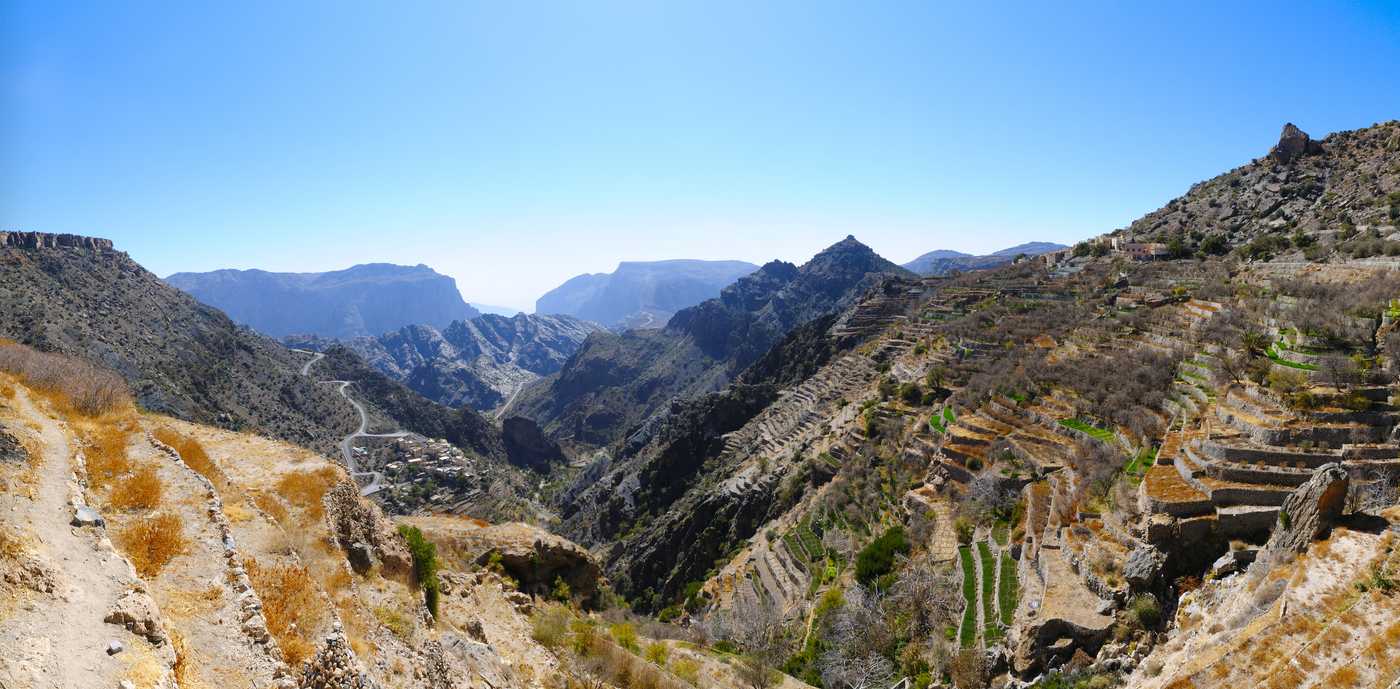
From Muscat the road runs inland toward Nizwa, through Birkat Al Mouz at the foot of the climb. Nizwa is in the same governorate. I keep putting it on the way, which is how the map is drawn and also how a person who hasn’t been there simplifies a country. The land out there is dry and open, a geology with little patience for fruit. Then the road goes up. Paved, steep. I’ve looked at it on maps and in other people’s photographs, which is a poor substitute for being on it, and I know that. Newspaper colour pieces sometimes write the mountain at about 2,700 m above the sea. Oman Observer uses that wording. The figure is rounded and peak-ish. I haven’t seen it offered as a surveyed summit. The villages sit on the plateau, about 2,000 m above sea level. I’m staying with the plateau.
At about 2,000 m above sea level the agriculture changes its mind. Pomegranate, apricot, walnut, peach, grape. Mediterranean fruit at this latitude is the agricultural reason the plateau is famous. The Green Mountain is a name that has to be earned every season, and the falaj is how it’s earned. Without the share, the terraces are stone.
I like Al Aqr, Al Ayn, and Ash Shirayjah for a reason that will sound small. They are close enough to walk. The piece of mountain I want is a morning’s loop, not a range. Abandoned houses on one side of a path, irrigation still running on the other. Photographs love the empty houses. I keep looking at the channel.
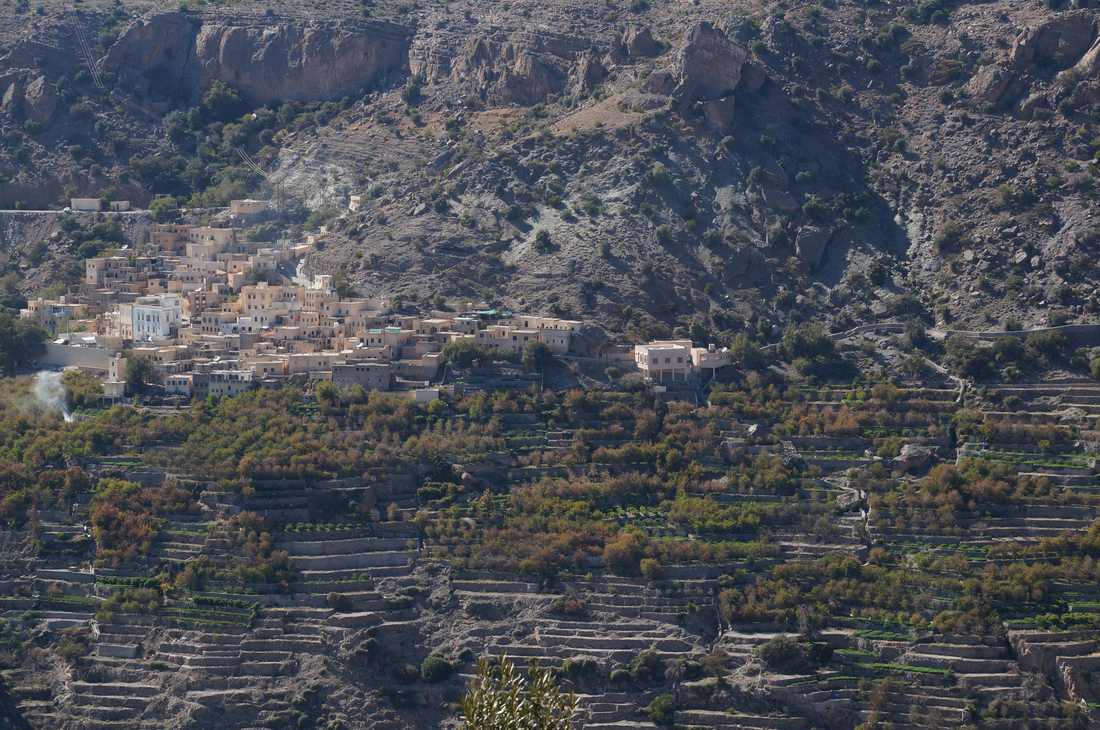

Wadi Bani Habib sits nearby: a mud hamlet that’s been left, orchards still irrigated. The houses stopped. The water didn’t. If you need a single picture of what an aflaj system is for, that pairing will do more than a terrace in full fruit.
I don’t know how the loop sits on the ground, which village you pass first, whether Ash Shirayjah comes as a spur or a bead on a string. Maps are confident. I’m not going to copy that confidence into a sequence and call it a walk I’ve imagined too clearly.
spring
In spring, for a few weeks, the terraces put on Ward Al Jabal, the mountain rose, which is the damask rose, Rosa damascena. Sources disagree on the exact weeks. March into April is where most of them land; some run on toward May. I spent part of an afternoon trying to pin a fortnight and then put the calendar down. Harvest is widely reported as an early job, before the day’s heat takes the scent. I haven’t smelled it. Petals go into traditional clay ovens, al-duhjan in a Times of Oman piece; pots and cloth strainers show up in other accounts. I had copper stills in a wishlist line I wrote myself, before I checked. I can’t stand behind the metal. The mountain still makes rose water in season. That’s the sentence that survives.
I found competing counts of plants and litres and put them down too. A precise number that might be wrong is worse than a generic fact that holds. I also don’t know how the shares are adjusted when the roses are on. I looked for a clean account of that and didn’t get one.
People will tell you to go for the roses. Go for the roses if that’s the sentence that gets you on a plane. The roses are a few weeks. The share is the year. I want those few weeks anyway, on the path between Al Aqr and Al Ayn, with the desert visible below. One mountain, two climates stacked. A gravity schedule on top of a country that otherwise runs on scarcity.
I’ve been trying to hear the channel from here. It’s a stupid project and I’ve been doing it anyway. The papers describe a timer. UNESCO describes values. I have a dozen travel pages that want to talk about a loop, then lunch. None of them will give me the sound at the hour that is theirs. Maybe a thin rasp in a stone cut. Maybe almost nothing, and the event is wet soil, not noise. I don’t know.
If I ever get there, I want to be on the path when a plot’s share arrives, and I want to be quiet about it. No photograph of the water. I want the unimpressive minutes: the channel doing a job, someone at a sluice, the next plot waiting. Then walk on. The hour will probably be ordinary. That’s what I’m hoping for.
The facts. Al Jabal Al Akhdar (Jebel Akhdar, Jabal Akhdar) sits in the Al Hajar mountains, Ad Dakhiliyah Governorate, Oman. The inhabited upland is the Saiq Plateau, about 2,000 m above sea level. Muscat International Airport (MCT) is the gateway. Nizwa, in the same governorate, is the honest city to aim at; the drive from Muscat is roughly two to two and a half hours, via Birkat Al Mouz at the foot of the climb. Go in spring if you want the damask roses, a window of a few weeks that sources place around March and April and sometimes into May. The terraces work all year. A Royal Oman Police checkpoint at the foot of the mountain road turns away vehicles that are not 4WD. The road itself is paved and steep.
Sources
- Photo: albinfo, CC-BY-SA 4.0 · img/al-ayn-village.jpg
- Photo: albinfo, CC-BY-SA 4.0 · img/al-ayn-falaj.jpg
- Photo: albinfo, CC-BY-SA 4.0 · img/ash-shirayjah.jpg
- Photo: Philipp Weigell, CC-BY 3.0 · img/jebel-akhdar-terraces.jpg
- https://experienceoman.om/destinations/al-dakhiliyah
- https://www.omanobserver.om/article/1162333/oman/al-jabal-al-akhdhar-and-jabal-hatt-popular-escapes
- https://en.wikipedia.org/wiki/Jebel_Akhdar_(Oman)
- https://www.omanobserver.om/article/1132662/oman/ro-41-million-jabal-akhdhar-water-project-launched
- https://en.wikipedia.org/wiki/Saiq
- http://www.pogodaiklimat.ru/station/41254.htm
- https://www.omran.om/index.php/projects/alila-jabal-akdhar
- https://www.omanobserver.om/article/1108346/oman/pomegranate-season-peaks-in-jabal-akhdar
- https://whc.unesco.org/en/list/1207/
- https://timesofoman.com/article/161220-al-ain-village-where-nature-meets-heritage
- https://www.watermuseums.net/campaigns/valuing-ancient-water-cultures/omanic-aflaj
- https://whc.unesco.org/en/news/267/
- https://en.wikipedia.org/wiki/Aflaj_Irrigation_Systems_of_Oman
- https://whc.unesco.org/en/list/1207/maps/
- https://ishraqa.unizwa.edu.om/article_169721.html
- https://www.fao.org/fileadmin/user_upload/rome2007/docs/Water_Managment_Drylands_Review%202.pdf
- https://www.academia.edu/65114263/Study_on_water_distribution_management_of_aflaj_irrigation_systems_of_Oman
- https://www.researchgate.net/publication/259931277_Aflaj_Irrigation_Systems_of_Oman_The_Way_of_Water_Distribution
- https://ishraqa.unizwa.edu.om/article_176924.html
- https://whc.unesco.org/en/list/1207/video/
- https://seasons.experienceoman.om/en/landing/24321/rose
- https://www.lonelyplanet.com/oman/al-dakhiliyah-region/jebel-akhdar/attractions/al-aqor/a/poi-sig/1610493/361111
- https://timesofoman.com/article/159976-al-aqar-village-a-summer-haven-and-heritage-destination-in-jabal-al-akhdar
- https://www.nationalgeographic.com/travel/article/paid-content-visit-jabal-akhdar
- https://www.omanobserver.om/article/54561/Features/the-small-mosque-at-the-old-village-of-wadi-habib
- https://www.lonelyplanet.com/oman/al-dakhiliyah-region/jebel-akhdar/attractions/wadi-bani-habib/a/poi-sig/1610492/361111
- https://www.atlasobscura.com/places/wadi-bani-habib
- https://experienceoman.om/media/pigfokjz/oman-tourism-directory.pdf
- https://www.roughguides.com/oman/western-hajar/jebel-akhdar-saiq-plateau/
- https://omannews.gov.om/topics/en/132/show/112373
- https://www.omanobserver.om/article/1168499/oman/rose-harvest-season-begins-in-al-jabal-al-akhdhar
- https://www.omanobserver.om/article/1187695/features/lifestyle/a-harvest-of-heritage-in-al-jabal-al-akhdhar
- https://timesofoman.com/article/6857-rose-water-of-jebel-akhdar-in-oman
- https://timesofoman.com/article/114559-roses-are-in-full-bloom-in-jabal-akhdar
- https://www.omanobserver.om/article/1152446/features/culture/sharing-the-secrets-of-rose-distillation-in-jabal-akdhar
- https://www.omanobserver.om/article/1169160/features/culture/explore-the-rose-filled-wonders-of-jabal-akhdar-at-the-dehjan-project
- https://www.omanobserver.om/article/52395/Features/the-rose-water-conundrum
- https://timesofoman.com/article/144868-a-pink-carpet-of-roses-welcomes-visitors-at-al-jabal-al-akhdar
- https://www.muscatairport.co.om/content/to-from
- https://prod.mtcit.gov.om/ITAPortal/Pages/Page.aspx?NID=873111&PID=1342526
- https://timesofoman.com/article/76777