Harar, Ethiopia: the walled city that faces inward

.jpg)
Rimbaud stopped writing poetry at around twenty and spent most of the last decade of his life between Aden and Harar, a walled city in eastern Ethiopia, dealing in coffee and, for one big venture, guns. I have never understood that, and understanding it is not available from a chair in front of a screen. Which is where I am. I have not been to Harar. I have been reading about it for a couple of weeks, and the thing I can’t get out of my head isn’t Rimbaud at all. It’s the walls of the houses, and which way they face.
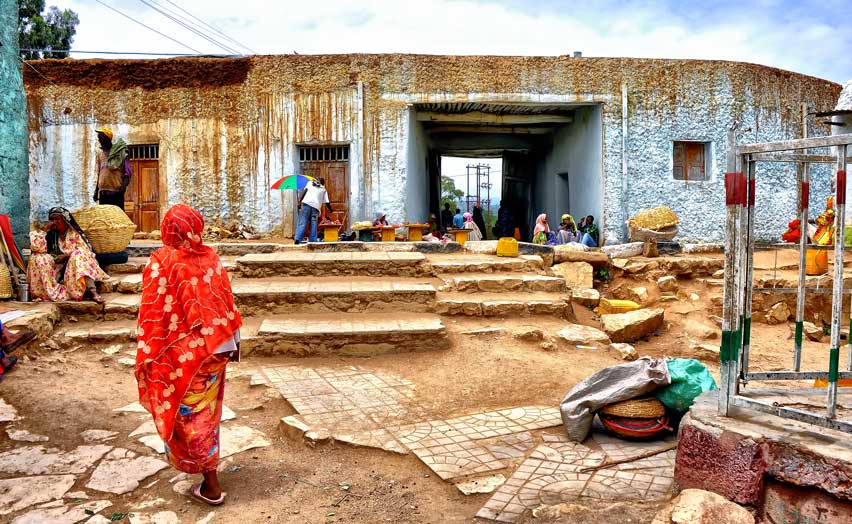
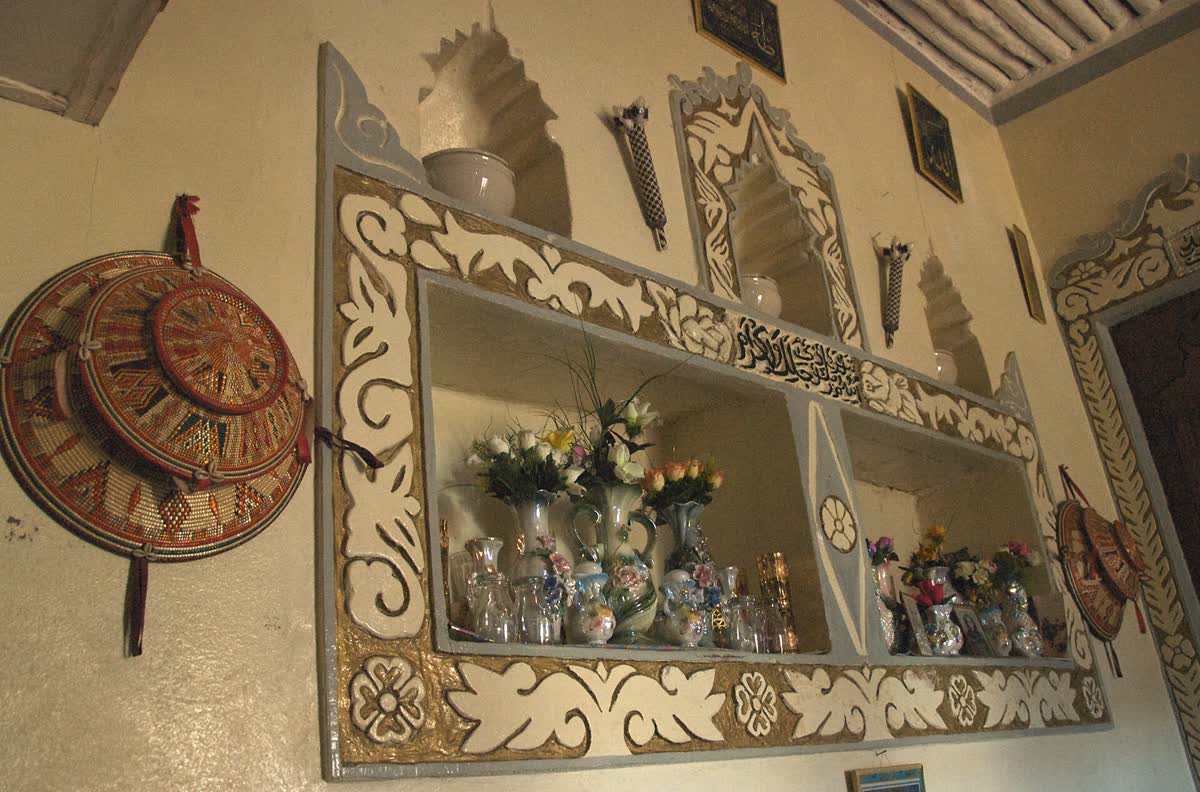
Here is the fact that started it. In a traditional Harari house, the gey gar (gey, the walled city; gar, house), the main room is hung with woven baskets and plates in rows, banked below a run of niches cut into the plaster, among them the small triangular and ogee-arched ones, the tilli taqet. The imported porcelain sits inside those. It’s the family’s whole visible wealth, arranged as decoration. And none of it faces the street. From the alley you get a wall. A door of plain planks or iron, some whitewash, maybe a colour. Most of the windows look onto the courtyard. The entire display is pointed inward at the people who live there and the people they let in.
.jpg)
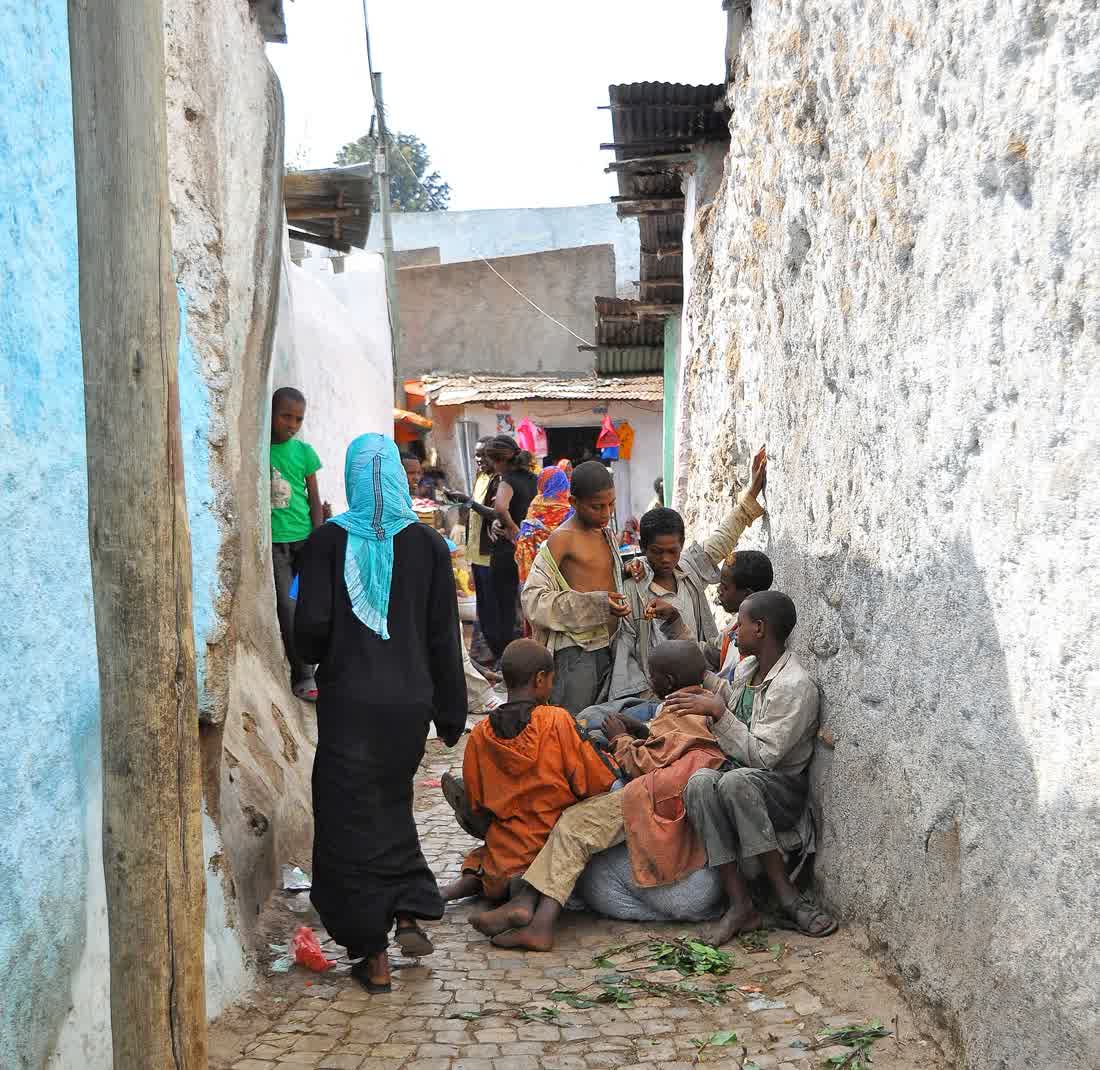
I want to say plainly what I think that means, because the piece falls apart if I hedge it. A city arranged that way is not austere. The austerity is a misreading you perform from outside. Almost every place I’ve written about wanting to visit does the reverse: the facade is the offering, the interior is private and often disappointing, and the tourist economy runs on the outside of buildings. Harar inverts the whole arrangement. The street is the plain part. You have to be brought in.
That’s a thing I keep testing against my own instincts and can’t shake. I’m the kind of person who arranges a room and then never has anyone over. The Harari version is better in a way that stings a little: the arrangement assumes the guest.
The scale matters here, and it’s small. The Jugol, the walled old town, is 48 hectares by UNESCO’s inscribed figure, half a square kilometre, ringed by a wall built between the thirteenth and sixteenth centuries with five historic gates and more added after the Abyssinian conquest in the late 1880s. (Other sources give the area larger, up to a full square kilometre, which is part of why I’m naming whose number I’m using.) Inside it there are 368 alleys, a count that comes from the Ethiopian tourism authority, which uses the larger area figure. A nineteenth-century observer recorded that the lanes follow the random conformation of the houses, that nobody laid out streets and then built along them, though by then there were already five major roads running out to the five classical gates. That number of alleys is worth sitting with whichever area you believe. Even at the generous square kilometre it is a town you could cross in a quarter of an hour if the streets ran straight, and they don’t. The houses climb the hill in terraces, so there is a view to be had, and the view won’t tell you anything. The substance is behind the plaster. UNESCO inscribed Jugol in 2006, and the case rests largely on the houses: the townhouses with their exceptional interior design, in UNESCO’s own words, are the most spectacular part of the city’s heritage. Not a monument you photograph from across a square.
I keep circling back to coffee, and I want to be careful, because this is where a piece like this usually starts inventing. The eastern Ethiopian highlands around Harar produce a coffee sold under both Harar and Harrar, spelled either way by importers on the same shelf, which is a small nuisance if you’re searching. Even the FAO writes it with one r, the sun-dried harar brand of Arabica grown in the area. Sun-dried is the processing: the cherry left to dry whole around the bean instead of being washed off. The flavour gets described as blueberry and wine, and I’ll leave that as the trade’s description rather than mine, because every source I found for it was somebody selling the bean. What I cannot tell you, because I haven’t stood in the market and watched, is how much of the city’s daily money moves through coffee versus khat, the mild stimulant leaf that grows in the same region and is chewed socially across the Horn. Everything I’ve read says khat is enormous there commercially. I’d want to see which one the trucks are actually carrying before I said more.
The detail that made me want to go, the one I’d give you if I had ten seconds, has nothing to do with the money. Coffee in a Harari house is a thing done sitting on the floor of a room whose walls are covered in bowls, in a spot the room is built around. The main room has raised platforms at different heights, five of them, and where you sit is not casual: one of them, the amir nadaba, is where the guest of honour and the master of the house sit. The house is a piece of social architecture with the seating built in.
There’s a version of this essay that turns Harar into a metaphor and I don’t want to write it. The inward-facing house is not a lesson about modern life. It’s a building technique from a specific hot, walled, densely-packed Muslim trading town where privacy was structural and hospitality was the currency, and it makes sense there for reasons that are local. What I take from it isn’t a lesson. It’s a correction to how I read streets.
Because I do read them wrong. When I look at photographs of a plain alley in a place I don’t know, my default is to think poor or closed or not much here, and Harar tells me flatly that the street is not evidence. Some cities put their money on the outside and some put it on the inside, and I’ve been assuming the first arrangement is the normal one because it’s the one I’ve seen most.
.jpg)
The other thing about Harar that everyone mentions, and I’ll mention it once and move on: at night, outside the wall, a man feeds meat to wild hyenas that come in from the scrub, and this has become the thing tourists go for. It’s real, the hyenas are wild, and the visitor pays a negotiable rate. The nightly feeding looks like a mid-twentieth-century invention, the fifties or the sixties depending who you ask, and the accounts of who started it and why don’t agree with each other at all. That disagreement is the interesting part. It makes the whole thing a modern attraction wearing an ancient face, and exactly the kind of headline the rest of this piece exists to look past. The hyenas face outward. Everything else in Harar doesn’t.
Here’s my admission, and it has a cost. I’ve been reading about the gey gar for two weeks and I could not tell you what one smells like, or how dark the main room is at three in the afternoon, or whether the baskets are dusty. Those are the only three things I’d want to know. The interior is the entire subject of the essay, and the interior is precisely what research can’t reach. I can describe the arrangement of a room I have never been inside, which is a strange sentence to write and an honest one.
Nor can I tell you the current situation on the ground. Eastern Ethiopia has been through real instability in recent years, and anything I said about how easy or safe it is to get to Harar right now would be a guess dressed as advice. In its advisory of 1 April 2026, the US State Department puts Ethiopia at Level 3, Reconsider Travel, as the overall country rating, with more than a dozen areas carved out at Level 4, Do Not Travel: Tigray, Afar, Amhara, Gambella, Benishangul-Gumuz, Sidama, the Central, South and Southwest Ethiopia regions, named zones of Oromia, and 50 km bands along the Somalia, Sudan, South Sudan and Kenya borders. Harar is in none of them. That April update also added exit bans and communications disruptions to the list of risks, which is worth reading closely if you’re the kind of traveller who assumes leaving is the easy half. The UK Foreign Office, last updated 29 May 2026, presents its restrictions differently, against all travel to some parts of the country and against all but essential travel to others, and Harar is currently in neither category. The restricted zones in the Somali region start close by: a 30 km strip along the Somalia border in Fafan zone, which is the zone you pass through going out via Jijiga, and Siti zone up to the north beyond Dire Dawa. The Oromia restrictions sit elsewhere in that region, west and south. The lists change at short notice. Check your own government’s current guidance before you plan anything. I mean that as a real caveat, not a disclaimer.
One thing I’d have liked to do is already gone. Elisabeth-Dorothea Hecht, writing in the Journal of Ethiopian Studies in 1982, mentions in a single sentence that a walk around the outside of the wall took about an hour in 1968, with some interruptions, and is no longer possible. Building outside the wall started around 1970 and had closed the circuit well before she published; it was already gone when she did her fieldwork in 1975. That’s a small loss and I only know about it because somebody wrote the hour down before it stopped being true.
What I think I’d do, if I got there, is not much. Not the hyenas. I’d want to be in one of those rooms at the hour when the light is coming through a small opening onto a wall of hung plates, in a house someone lives in, with coffee, having been brought in rather than having walked in. That’s the whole trip. It is also the one thing you cannot arrange from outside, which might be the point Harar has been making at its street-facing walls for centuries. The houses themselves are younger than the wall, mostly eighteenth and nineteenth century, and the elaborately carved doors came later still, around the turn of the twentieth century. The arrangement is older than any of them.
Rimbaud had already stopped writing when he got here, and sold coffee for a decade. I still don’t understand it. I’ve moved from thinking it was a renunciation to suspecting it was just a man who found a room he liked being in.
The facts
Harar is in eastern Ethiopia, capital of the Harari Region, about 525 km east of Addis Ababa by road on UNESCO’s figure; Dire Dawa is the nearest city with an airport and the usual gateway. The walled old town, Jugol, is a UNESCO World Heritage Site (inscribed 2006) and covers 48 hectares by UNESCO’s inscribed figure, half a square kilometre, though other sources put it higher. Its wall was built between the thirteenth and sixteenth centuries, with five historic gates and further gates added after the Abyssinian conquest of the late 1880s. The traditional Harari house is the gey gar; the surviving stock is largely eighteenth and nineteenth century. Coffee from the surrounding highlands is exported under both Harar and Harrar spellings and is dry-processed, the cherry sun-dried whole. The US State Department advisory of 1 April 2026 rates Ethiopia Level 3, Reconsider Travel, overall, with many areas at Level 4, Do Not Travel, and flags exit bans and communications disruptions among the risks; Harar is not in a Level 4 area. The UK Foreign Office, last updated 29 May 2026, restricts by region and does not currently restrict Harar. Confirm current safety and access with your own foreign ministry before travelling; the regional situation has not been stable.
Sources
- Photo: Rod Waddington, CC BY-SA 2.0 · harar-gate.jpg
- Photo: A. Davey, CC BY 2.0 · harari-house-interior.jpg
- Photo: Rod Waddington, CC BY-SA 2.0 · harar-alley.jpg
- https://adoption.state.gov/content/travel/en/traveladvisories/traveladvisories/ethiopia-travel-advisory.html
- https://www.foxnews.com/travel/american-tourists-warned-arrest-jail-time-taking-photos-pocketing-souvenirs-locale
- https://et.usembassy.gov/travel-advisory-ethiopia-april-2026/
- https://www.travelandtourworld.com/news/article/ethiopia-travel-alert-2026-us-warns-of-exit-bans-and-safety-risks-what-every-traveller-must-know/
- https://www.gov.uk/foreign-travel-advice/ethiopia
- https://www.mensjournal.com/travel/ethiopia-travel-advisory-updated-kidnapping
- https://www.newsweek.com/us-updates-travel-warning-reconsider-travel-11798458
- https://en.wikipedia.org/wiki/Sitti_Zone
- https://en.wikipedia.org/wiki/Dire_Dawa_Airport
- https://everythingharar.com/wp-content/uploads/2017/02/The-City-Of-Harar-And-The-Traditional-Harar-House-Hecht.pdf
- https://shs.hal.science/tel-00525518v1/html_references
- https://sah.org/2015/02/11/harar-and-old-goa-architectural-hybridity-on-the-periphery/
- https://archiabyssniya.wordpress.com/art-vs-nature/landmarks/design-traditions/cultureheritage/harari-home-nedeb-gar/
- https://www.ovpm.org/city/harar-jugol-ethiopia/
- https://en.wikipedia.org/wiki/Harar
- https://www.worldheritagesite.org/list/harar-jugol/
- https://visitethiopia.et/space/harar-eco-tourism-village
- https://africanworldheritagesites.org/cultural-places/ancient-ethiopia/harar.html
- https://everythingharar.com/harar-jugol-the-fortified-historic-town-unesco/
- https://culturalheritageonline.com/places/harar-jugol-the-fortified-historic-town-ethiopia/
- https://www.fao.org/4/x6939e/X6939e12.htm
- https://pmc.ncbi.nlm.nih.gov/articles/PMC4197201/
- https://www.xcept-research.org/publication/fixing-the-price-the-politics-of-the-khat-trade-between-ethiopia-and-somaliland/
- https://www.bradtguides.com/the-hyena-men-of-harar/
- https://en.wikipedia.org/wiki/Spotted_hyenas_in_Harar
- https://rimbaud-arthur.fr/en/places/harar/
- https://www.britannica.com/biography/Arthur-Rimbaud/Later-life