Valletta, Malta: the fortress that became a city

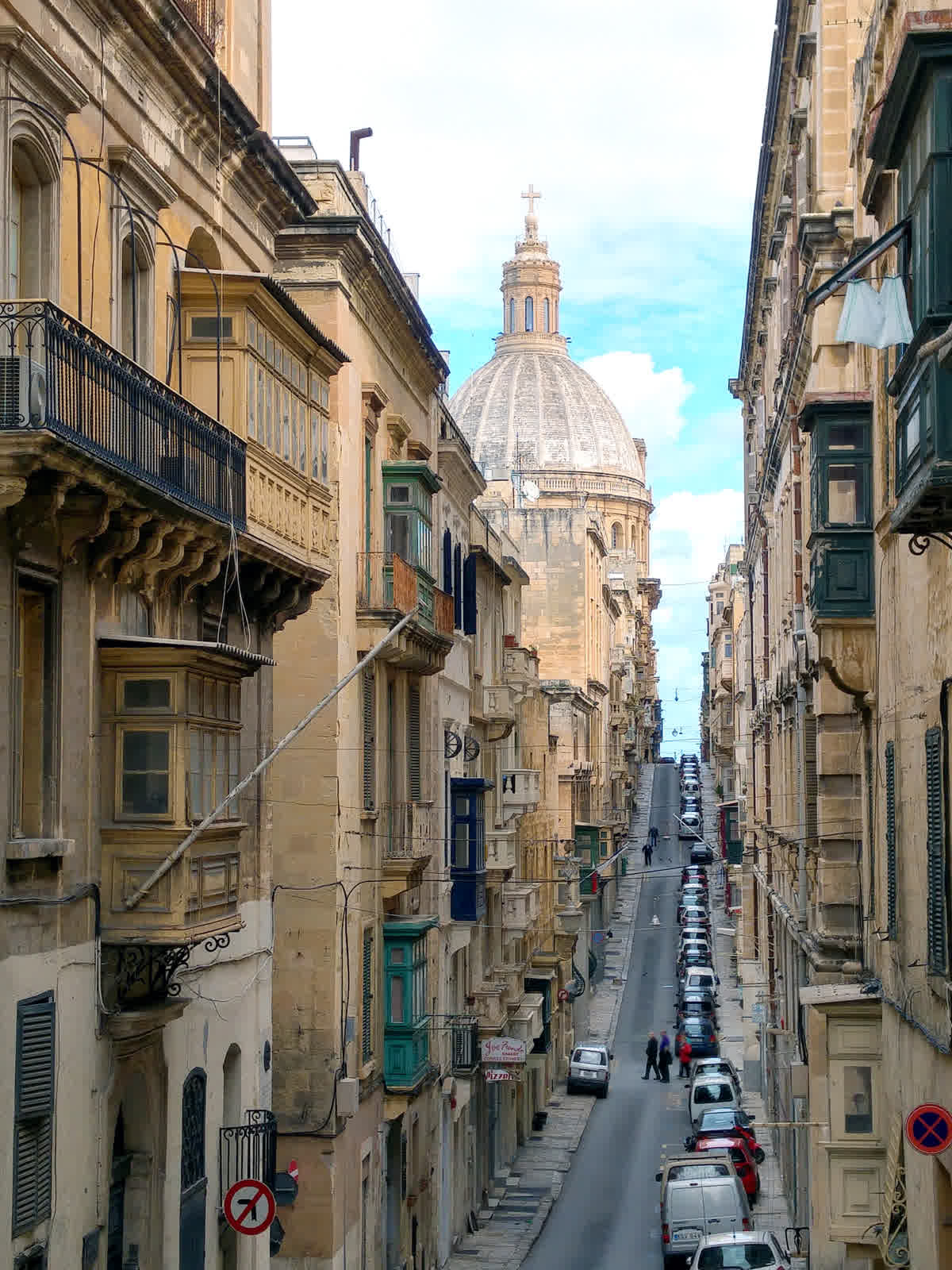

Valletta is about a kilometer long, and the men who built it laid it down as a single straight grid, wide ruled streets carved over a bare limestone peninsula and the whole tip wrapped in bastioned wall. That’s the first fact I learned, and the one I keep returning to. A capital drawn as a weapon, a fortress and a town planned as one thing over an empty spit of rock, severe by design, offering an attacker no crooked corner to disappear into. I have not been to Malta. Everything I say here I owe to books, maps, and photographs, and I want to be honest about that before I say anything else, because the wanting is the whole of what I have.
I came to it backward, through a painting. Caravaggio, on the run from a death sentence in Rome, washed up on the island in 1607 and painted The Beheading of Saint John the Baptist for the oratory of the Knights. It is the largest canvas he ever made and the only work he ever signed, and he signed it in the wrong place: down in the dark pool of blood running from the Baptist’s half-severed neck, in letters that seem to spell out of the wound itself. I’ve read that the painting still hangs in the room it was made for, which is rare enough to stop me cold. Most of the great pictures have been pried loose from their walls and hung under museum spotlights in cities far from where they were meant to be seen. This one stayed. You stand where the confraternity stood, in the light the painter judged by, and that is a kind of continuity I didn’t know I was hungry for until I read about it.
But the painting sits inside the larger thing, which is the city, and the city is the puzzle. Let me state the position I have been circling: Valletta is the most interesting argument I know of between what a place was built to do and what people made it become. It was built to do war. In 1565 the Ottomans laid siege to the island for just under four months, thousands against a few hundred Knights of the Order of Saint John and the Maltese who fought beside them, and when the siege broke, the Grand Master Jean de Valette decided the Order needed a real fortress on the high ground of the Sciberras peninsula. He got the money and an engineer, Francesco Laparelli, sent from the pope, and Laparelli drew the grid. This was a defense first, a town ordered to grow inside a fortress that had been planned before it.
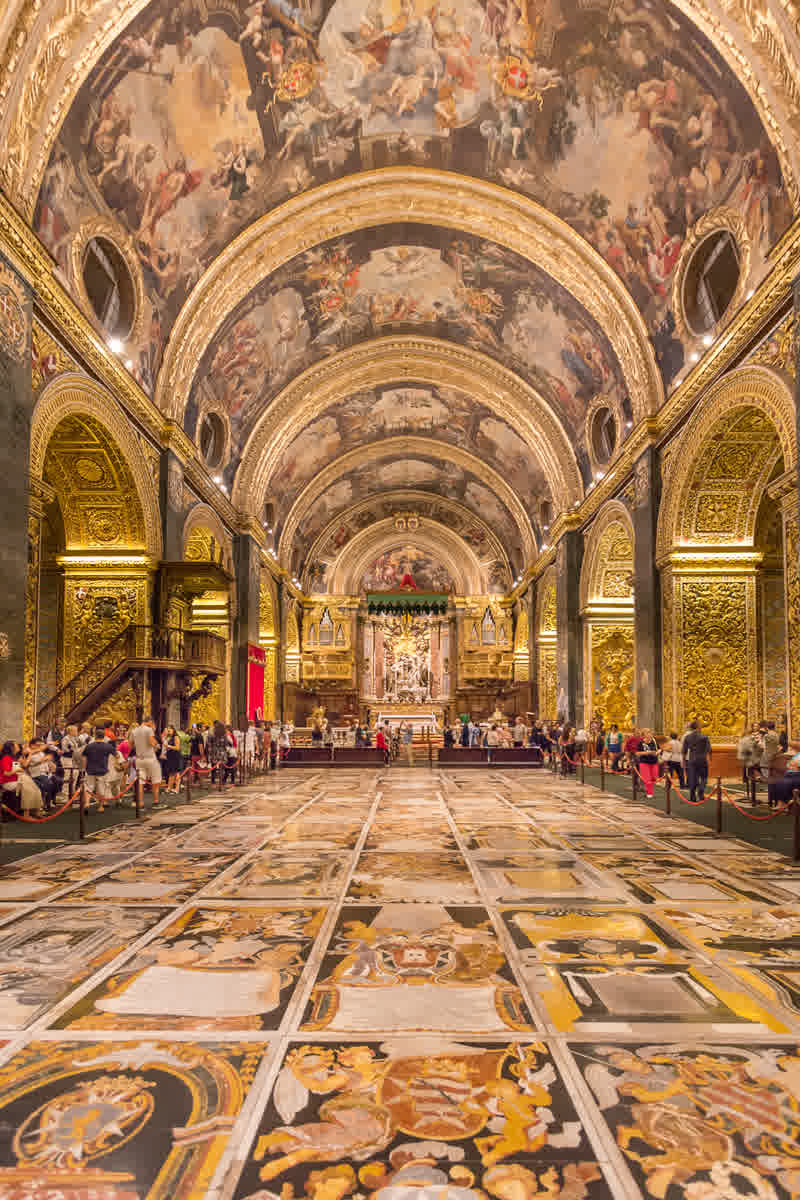
The severity was the point. Straight streets, a bastioned wall thrown around the whole tip of the peninsula, the sea on three sides. What gets me is what happened next, in the century after the walls went up, when the same Order that had planned the place for killing filled it with the most extravagant Baroque interiors in Europe. The co-cathedral of Saint John looks plain from the street, a flat honey-colored front with two bell towers, almost a barracks. Inside, every surface is carved, gilded, painted, and the floor is a carpet of marble tomb-slabs for the knights, inlaid with skeletons and trumpets and coats of arms, each one a small riot. The gun and the gilt hold the same walls. I find that tension more moving than either thing alone would be.

The stone does a lot of the work, and it has a name I had to learn: globigerina, a soft yellow limestone quarried on the island, named for the tiny fossil plankton pressed into it. It cuts like cheese when it comes out of the ground and hardens in the air, which is why a whole city could be raised in a generation, and it holds a color somewhere between honey and pale gold that photographs cannot quite agree on. In some pictures the streets look bleached; in others they burn at the end of the day like the whole place has been dipped in tea. This is one of the things I most distrust in my own longing. I don’t know which of those is the real Valletta, because color at that latitude is a thing you have to stand inside to judge, and I have judged nothing. I’m reading light off a screen and calling it knowledge. That’s the cost of writing about a place from a chair: I can tell you the stone’s name and not tell you its true color, and I would trade the name back for the color in a heartbeat.
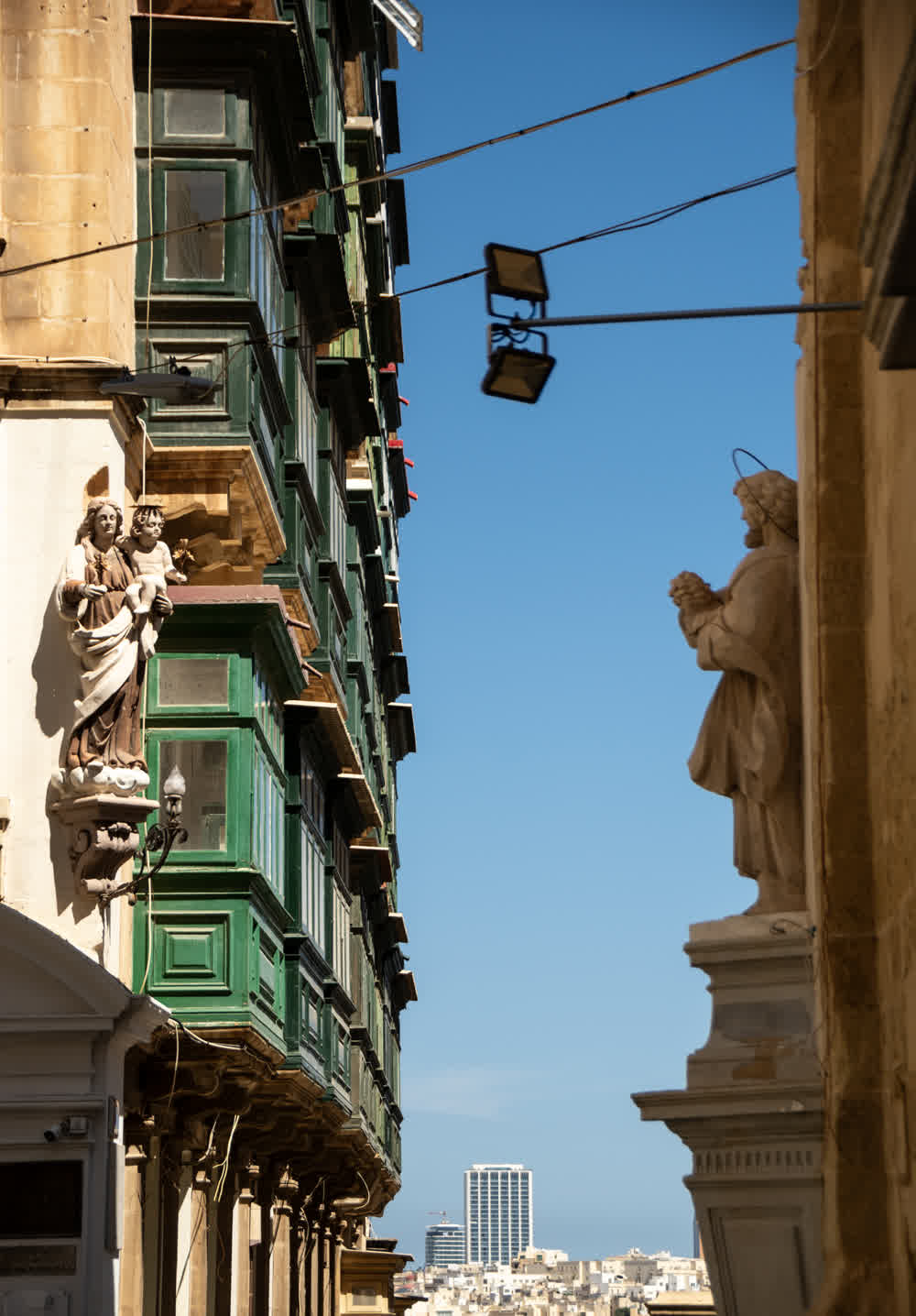
Then there are the balconies, which are the face the city turns to you. The gallarija, the enclosed wooden balcony that hangs off the stone fronts, painted green or ochre or oxblood, glassed in on three sides so a person could sit inside and watch the street without being seen from it. They are everywhere in the photographs, stacked and jutting, and they soften the grid the way nothing else does. A fortress plan makes streets that give you nowhere to stand unwatched; the gallariji make windows you can watch from, and something about a whole city deciding, over the centuries, to lean out over its own severe streets in painted wooden boxes strikes me as the human answer to Laparelli’s ruler. I’ve read a few competing stories about where the form came from, Arab mashrabiya screens, Spanish or Sicilian precedent, and I can’t referee that from here. I only know the shape, and that the Maltese made it theirs.

The Maltese call the city Il-Belt, which just means “the city,” the way you would say “town” and everyone knows which one. There’s a confidence in that. One capital, one word.
I want to be careful not to freeze it into a museum, because the thing I keep finding is that Valletta refuses to hold still. Take Strada Stretta, Strait Street, one narrow line in the grid that became the drinking-and-dancing quarter, the place sailors went, then fell quiet for decades, and has been coming back in the last several years with small bars and music in rooms that had been shut a long time. And take the entrance to the city itself, which Renzo Piano redrew in the last decade or so: a new City Gate cut cleaner and deeper into the old bastions, an open-air theater left in the bombed shell of the former opera house, and a Parliament building raised on slender pillars, its two great blocks clad in stone milled into rough and smooth so the light catches them like the old walls do. I’ve read that Maltese opinion on the Piano work is genuinely split, some seeing a brave continuation and some seeing a cold intrusion, and I think a city that can still argue that hard about its own front door is alive in the way that matters. UNESCO put the whole peninsula on the World Heritage list in 1980, and the danger of that stamp is always the same, that a living place gets embalmed by its own importance. Valletta seems to have dodged it, at least in the accounts I trust.
Here’s what I can’t get from any of this, and what keeps the wanting sharp. I can learn the grid, the siege year, the painter’s signature in the blood, the fossil in the stone, the word for the balcony. What I can’t learn is the sound: what a straight limestone street does to footsteps at nine at night, whether the gallariji rattle in the wind off the Grand Harbour, how the bells of Saint John’s carry across water that was once ringed with gun batteries. Facts travel. The acoustics of a place stay home.
So I keep the map open on my desk, the tip of the peninsula, the ruled streets running down to the water, and I try to imagine standing at the top of one and looking straight along it to the sea. The gunner I put at my shoulder there is mine, not the record’s, an image I can’t prove and can’t quite shake. I haven’t earned that view. I would like to go and stand in it, in the wrong light or the right one, and find out which of my honey-colored guesses was true.
Sources
- Photo: Acediscovery, CC-BY 4.0 · img/hero.jpg
- Photo: Kurjuz, CC-BY-SA 4.0 · img/st-johns-nave.jpg
- Photo: Julian Lupyan, CC0 1.0 · img/gallarija-balconies.jpg
- UNESCO World Heritage: City of Valletta
- St. John's Co-Cathedral: Caravaggio
- Britannica: The Beheading of St. John the Baptist
- Wikipedia: Great Siege of Malta
- VisitMalta: Valletta History
- Wikipedia: Geology of Malta
- Wikipedia: Gallarija
- RPBW: Valletta City Gate
- Wikipedia: Valletta