The intelligence of emptiness


The most important part of a room is the part nobody builds.
This is the claim behind ma (間), the Japanese word for the interval, and I want to take it further than the design magazines do. Ma usually gets translated as negative space, which makes it sound like a leftover, the patch a smarter layout would have filled. The word argues the opposite. Its kanji is a gate with something showing through the opening, and in the older forms that something is the moon. 間 is moonlight reaching you through a gap. The light is the point. The gate matters only because it leaves room for the light to arrive. Read that way, emptiness stops being the absence of content and becomes the condition for any content to mean a thing at all.
I’ll put the position plainly, so the rest of this has something to push against. In the things I find most alive, across buildings and music and the way a mind holds a question, the part that isn’t there is doing the real work, and it’s doing it on purpose.
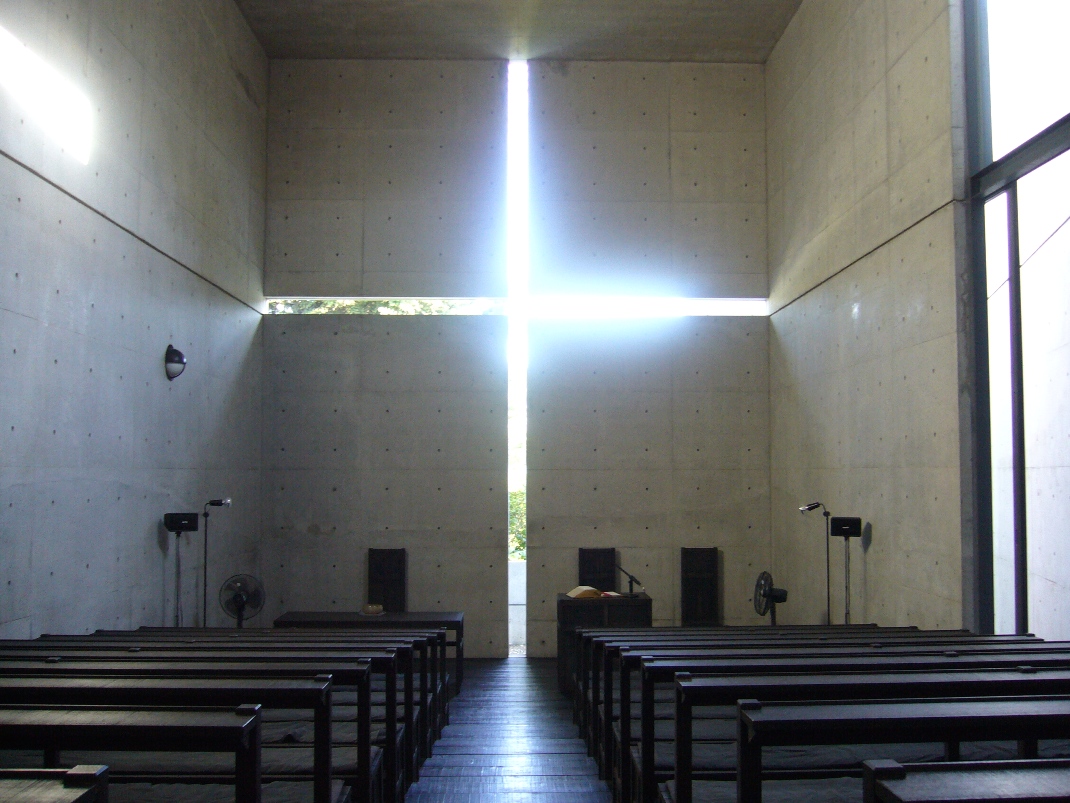
Start with something you can stand inside. Tadao Ando finished the Church of the Light in 1989, in Ibaraki, just outside Osaka. From the street it’s a concrete box, almost rude in its plainness. Inside, the wall behind the altar has a slit cut through it in the shape of a cross, and at the right hour the sun comes through that cross and lies across the dark room as raw light. Every photograph of the building is a photograph of that emptiness. Ando is direct about what he was after, and his philosophy puts the space first and treats the walls as servants of it: the space itself is the architecture, and the concrete is only what lets it exist. The cross is not something he added to the wall. It’s something he removed, and the removal is the whole building.
He does it with time as well. To reach the worship hall you pass a freestanding wall set at fifteen degrees, which routes you through a tight, turning corridor before the room finally opens. You’re compressed before you’re released. By the time you arrive you’ve been made small enough that the light feels large.
That sequence is the same move a composer makes with a rest, which is where Takemitsu comes in. Toru Takemitsu scored silence the way other composers score notes. In November Steps, from 1967, written for shakuhachi, biwa, and orchestra, he marked two long silences with held fermatas, deliberate stretches of quiet that run past any countable length. In standard Western notation a rest is a measured gap, a held breath between events, valued by how long it lasts. Takemitsu treated the silence as the event. He wrote that a single sound can be complete in itself, because its complexity lies in the formation of ma, which he called an unquantifiable metaphysical space of dynamically tensed absence. He left the shakuhachi and biwa players room to find their own ma, writing without a strong regular pulse so the quiet could breathe at the scale of a human breath instead of a metronome. The orchestra doesn’t pause so the soloists can rest. The pause is the thing the orchestra came to play.
So far this is an argument about aesthetics, and aesthetics can be waved off as decoration. The reason I keep circling ma is that the same structure turns up where it has nothing to do with beauty, in how we know things.
In 1817 Keats described what he called negative capability, the capacity of being in uncertainties, mysteries, doubts, without any irritable reaching after fact and reason. He meant it as praise, his name for whatever let Shakespeare write people he disagreed with and never flatten them into a single thesis. The phrase wandered far past poetry. The psychoanalyst Wilfred Bion borrowed it for the analyst who can sit with a patient inside not-knowing rather than rushing to interpret. The social theorist Roberto Unger used it for the refusal to lock the world into fixed categories. Both of them treat the willingness to stay in the open question as an engine, the place growth comes from, and not a failure to finish thinking.
Hold that next to Ando and Takemitsu and the shape is identical. The cross is a held opening in a wall. The fermata is a held opening in a score. Negative capability is a held opening in a mind. In all three the discipline is the same discipline, which is the refusal to fill. Anyone can add a window, a note, an answer. The harder thing is to leave the gap and then defend it against your own urge to close it.
I’ll admit where this turns personal, because it’s the part of my own enthusiasm I trust least. My instinct, always, is to resolve. Someone leaves a sentence hanging and I finish it for them. A question sits open and I reach to answer it before it’s done being a question. Writing this, I kept wanting to cap each section with a tidy conclusion, to tell you what it meant before you’d felt it mean anything. Every one of those impulses is the opposite of ma, and most days I lose to them. The cost is real and small and constant. It’s the conversations where I answered too fast and never found out what the other person was actually about to say.
There’s a version of this idea that should keep it honest, and it’s worth saying out loud so ma doesn’t float off into something consoling. Silence is not always charged presence. Sometimes it’s just loss. Bernie Krause spent fifty years recording habitats and found that a healthy ecosystem sounds like a full orchestra, every species evolved into its own frequency band so its call carries without colliding with the others. You can see biodiversity on a spectrogram as layered, legibly separated sound. When he returns to a logged or warming forest, the picture comes back with holes in it, frequency bands gone quiet, species dropped out of the ensemble. That silence means something died. So the gap is not automatically holy. An empty band in a forest and an empty cross in a wall can look identical on paper and mean opposite things. The whole difference is whether the emptiness was made on purpose or left behind by collapse.
That’s the line I’d keep, and it’s sharper than the version of ma that gets sold as a mood. The skill the concept actually asks for is the ability to tell the made silence from the abandoned one, and then to make more of the first kind on purpose, in a wall, in a bar of music, in the half-second after someone stops talking. I’m not good at it yet. I notice the gate. I keep wanting to close it before the moon gets through.
Sources
- Photo: Bergmann, CC BY-SA 3.0 · Wikimedia Commons
- ejable.com — kanji of moon
- jisho.org — 間
- MoMA — Church of the Light
- Wikipedia — Church of the Light
- Britannica — Church of Light
- Pritzker Prize — Tadao Ando
- Wikipedia — November Steps
- Wikipedia — Tōru Takemitsu
- Britannica — negative capability
- Wikipedia — Negative capability
- Poetry Foundation — negative capability
- Wikipedia — Wilfred Bion
- Wikipedia — Roberto Mangabeira Unger
- Wikipedia — Bernie Krause
- Emergence Magazine — Krause interview