Mostar, Bosnia: the bridge they rebuilt

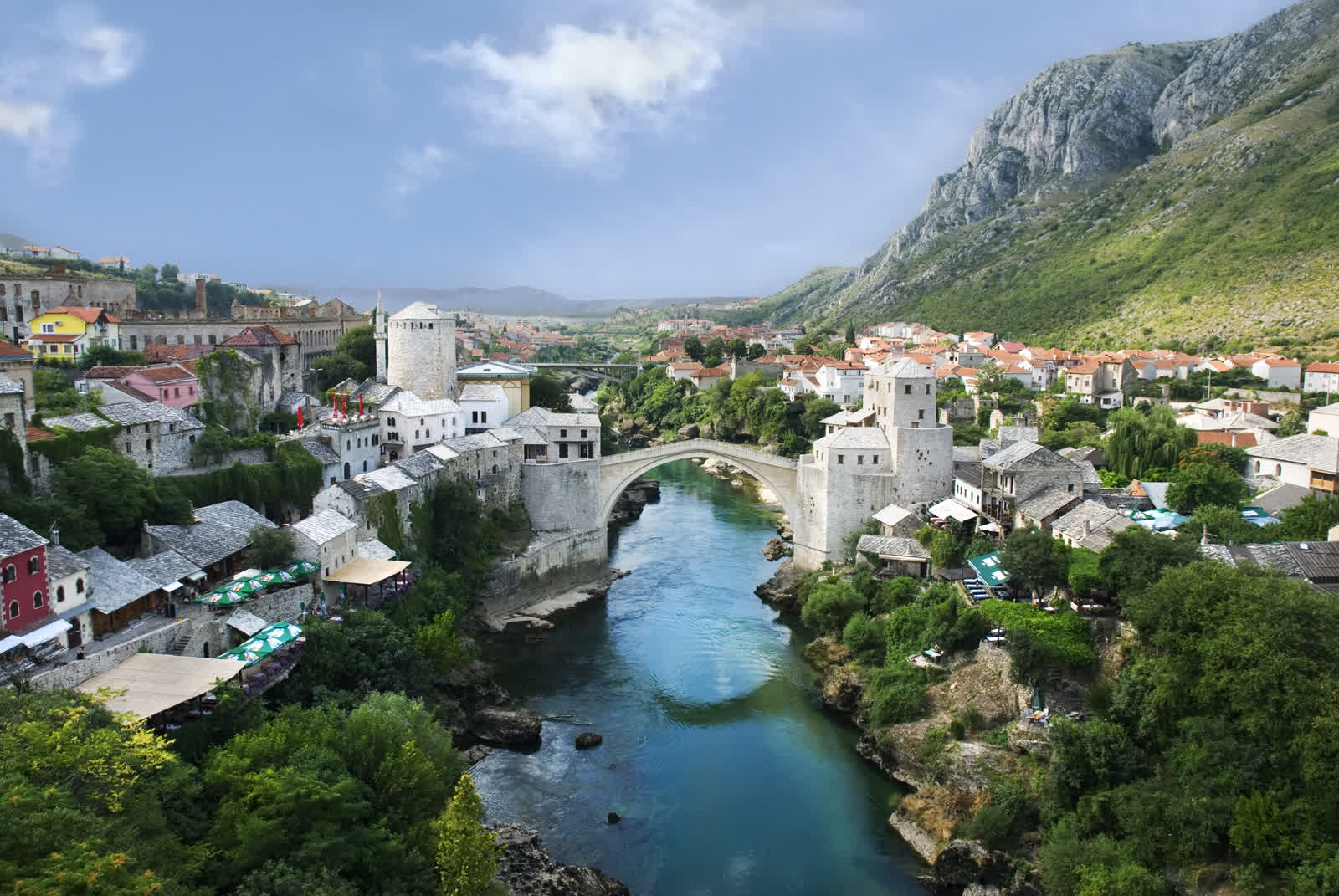

Croat shells hit the bridge in Mostar for two days. It fell on the morning of November 9, 1993, on the sixth shell of the day, at 10:16. It had stood for 427 years. The crews rebuilt it eleven years later, and here’s the claim I’ll defend for the rest of this: the rebuilt bridge is a different bridge, Mostar knows it’s a different bridge, and that knowledge is the thing I actually want to stand on.
I haven’t been. Everything below I’ve read, watched, or pieced together from photographs and other people’s accounts, and I want to be straight about that before I say another word, because a longing essay that pretends to firsthand authority is just a lie with nice lighting. I’ve never crossed the Stari Most, the Old Bridge. I’ve never put a hand on its stone.
Here’s what I know. The original was finished in 1566 under the Ottoman architect Mimar Hayruddin, commissioned in Suleiman the Magnificent’s reign. One stone arch, about 29 meters across, four meters wide, lifting maybe 20-some meters over the Neretva at its crown. For four centuries it was the load-bearing fact of the town: the thing the two banks agreed on. Then a war that ran on the logic of separating people who’d lived mixed found a bridge intolerable for exactly the reason bridges exist.
The reconstruction is where the story I’d been carrying turned out to be wrong, and that’s my admission. For years I told people the bridge was raised back up out of its own bones, that Hungarian Army divers pulled the fallen stones from the riverbed (true, many of them) and that those same stones were set back into the arch, every last one (that part’s mostly wrong). What I’d skipped is that the recovered stones had spent years underwater after being broken by ordnance, and a lot of them couldn’t carry load anymore. They were tested and found wanting. So the bulk of the new arch was cut fresh from tenelija, the soft local limestone the original masons used, quarried near the same source, though a share of the salvaged stone did go back into the rebuild. I don’t know the exact proportion, and I’ve found the reconstruction record hard to pin down on that point. But the shape of it I’m fairly sure of, and it cost me a tidier story than the truth. The cost was worth it. The truth is better. They didn’t resurrect the bridge. They studied its corpse and built a faithful copy using the same recipe, down to a traditional lime mortar mixed the old way. UNESCO listed it in 2005. A faithful copy is not the same as the dead thing returned, and Mostar, which lost more than a bridge, would be the last place to confuse the two.
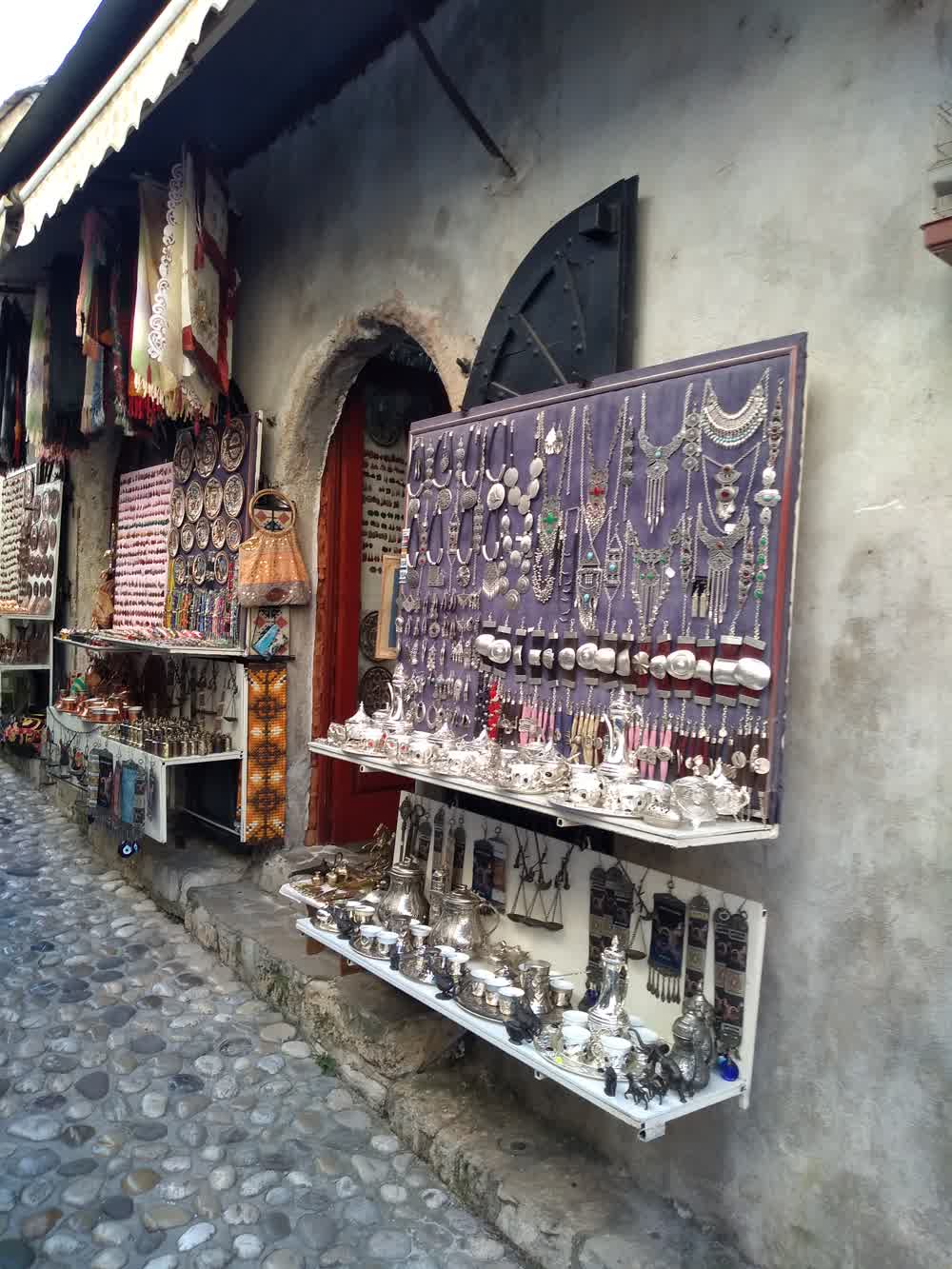

What pulls me there isn’t only the bridge, though. It’s the street that runs up to it. Kujundžiluk, the goldsmiths’ quarter, where the trade gives the lane its name (kujundžija is the goldsmith) and where people have been working metal into shape since the 1500s, back when this was an Ottoman trade hub. The stalls sell copperware now, but the name and the old craft go back to gold and silver. I like that the wishlist note I wrote for myself put the metalworkers before the bridge. It’s the right order. A town that can rebuild a 16th-century arch is a town that never stopped knowing how to make things by hand, and the bazaar is where you’d hear that, literally, in the tapping. I don’t trust the bridge as a symbol nearly as much as I trust the noise of a man who’s been working the same metal since before the war and didn’t stop for it.
There’s a detail I keep returning to. The young men who jump from the bridge into the Neretva, sometimes 20-odd meters of free fall into water that runs cold and green even in August because the river is fed from the mountains. They’ve done it for centuries, and there’s a club, the Mostari, who train the dive and run a competition off the parapet every summer. The name is the part I can’t let go of. Mostari means the bridge’s keepers, its guardians, and there’s something to a club that names itself for guarding the bridge and then performs that guarding by hurling its own bodies off the top of it. The dive is the bridge’s argument made with a body: that the distance between standing on the stone and hitting the water is survivable, that you can go down into the Neretva and come back up. The bridge itself made that argument and lost, in 1993, and then made it again.
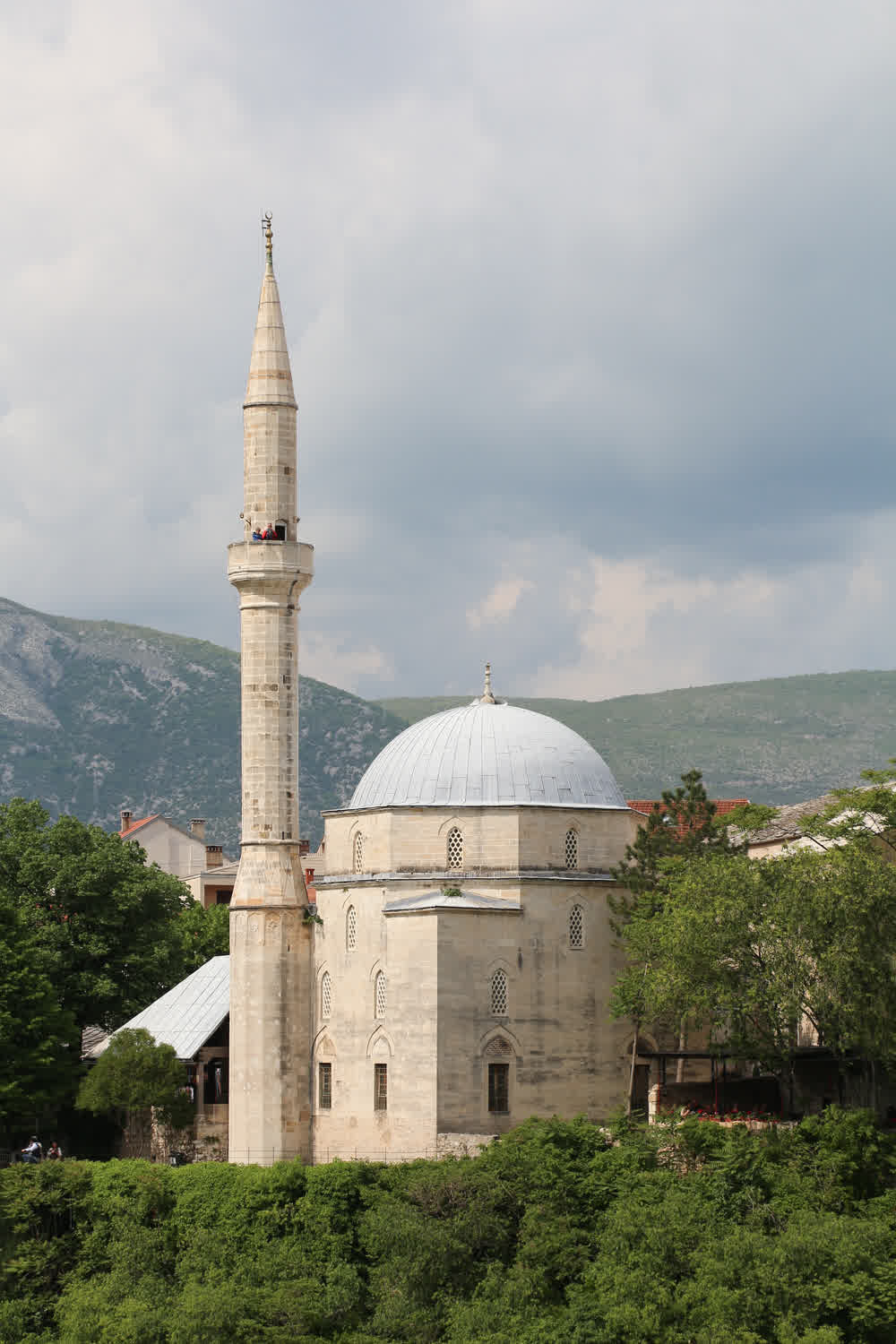

Above the river the old town, Stari Grad, keeps its Ottoman bones: the hamams, the mosques, the Koski Mehmed Pasha Mosque whose minaret I’ve seen in a hundred photographs taken by people who climbed it for the view back down onto the bridge. That’s the angle I’d want and the one I’m slightly embarrassed to want, because it’s the angle everyone wants, and standing in a line to photograph the most photographed object in Herzegovina is its own small admission of being a tourist rather than a person who belongs there. I’d do it anyway. I’d just try to do it quietly.
The reason the place sits at the top of my list, above places with more sun and easier flights, is that single sentence I wrote when I added it: a city that knows what it costs to put something back together. I believed that before I’d checked any of the dates, and checking them hasn’t loosened the grip. Most of what gets rebuilt in this world gets rebuilt cheaper, faster, in materials that lie about what they’re imitating. Mostar quarried the slow soft limestone and mixed the old mortar and accepted the years it took, on a structure that had already proven it could be destroyed in an afternoon. That’s either faith or stubbornness, and from where I’m sitting, which is not Mostar, which is a desk, I can’t tell the two apart and I’m not sure the town could either.
So I haven’t earned the crossing yet. What I have is the research, and a sentence I’ll only get to test by going: that the second bridge means more than the first one ever did, because the first one was only old, and the second one came back.
Where it is. Mostar, in the Herzegovina-Neretva canton of Bosnia and Herzegovina, on the Neretva River, roughly 43.34°N, 17.81°E.
Nearest gateway. Most travelers arrive overland from Sarajevo (about two hours north) or from the Dalmatian coast around Split or Dubrovnik in Croatia. Mostar has a small airport and a rail link to Sarajevo, but the coach and the train through the Neretva valley are the routes people actually use.
When to go. Late spring or early autumn. July and August bring the heat, the crowds, and the diving competition off the bridge, which is the busiest the old town gets; if the Mostari jump is the reason you’re coming, that’s the trade you make.
The one rule that matters. Mostar is a working town carrying real and recent history, not a stage set. The bazaar metalworkers are running businesses, not posing; the war damage you’ll still see on buildings off the tourist lane belongs to people who lived it. Spend in the Kujundžiluk, buy from the makers, and read the second bridge as what it is before you photograph it as scenery.
Sources
- Photo: Ramirez HUN, CC BY-SA 3.0 · img/hero.jpg
- Photo: 11sasapus11, CC BY-SA 4.0 · img/kujundziluk-bazaar.jpg
- Photo: Bernard Gagnon, CC BY-SA 4.0 · img/koski-mosque.jpg
- UNESCO World Heritage: Old Bridge Area of the Old City of Mostar
- Britannica: Stari Most
- Wikipedia: Stari Most
- RFE/RL: Mostar Bridge 30 years
- UNESCO: The Story of Mostar Bridge
- Mostar Tourism: Old Bridge Diving
- Mostar Tourism: Koski Mehmed Pasha Mosque
- Mostar International Airport
- Seat61: Sarajevo to Mostar by train