Luang Prabang, Laos: the city that starts with giving


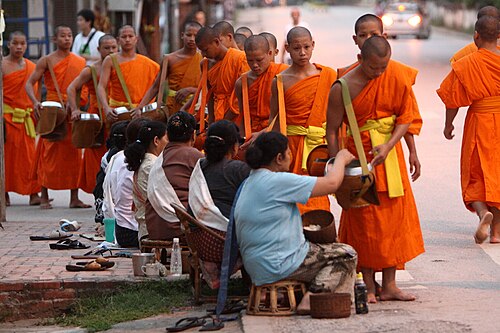
Before the sun clears the hills above Luang Prabang, a line of monks comes down the street in saffron robes, barefoot, single file, each one holding a lidded bowl against his hip. People kneel along the pavement with baskets of warm rice and press a small handful into each bowl as it passes. This is the tak bat, the dawn alms round, and it is the thing I most want to stand quietly near in Luang Prabang. I should say plainly, in case the wanting reads as memory: I have not been there. I have been reading about this town in northern Laos for a couple of weeks, and the picture I keep returning to is not a temple or a waterfall. It is the bowl, and the rice, and the fact that a whole town organizes its early morning around the act of giving food away.
That is the part I can’t stop thinking about. Most cities I’ve read my way into have a center that is a building or a square, a thing you walk toward. Luang Prabang’s center, as far as I can tell from the outside, is a verb. The day opens on people handing over sticky rice, khao niao, the short-grain rice they steam in bamboo and eat with their hands, and the monks walk the same route with the same bowls that this practice has used for a very long time. The rice is the offering because the rice is what there is. There’s something in that I want to test against the real morning air, and I can’t yet.
A town on a tongue of land
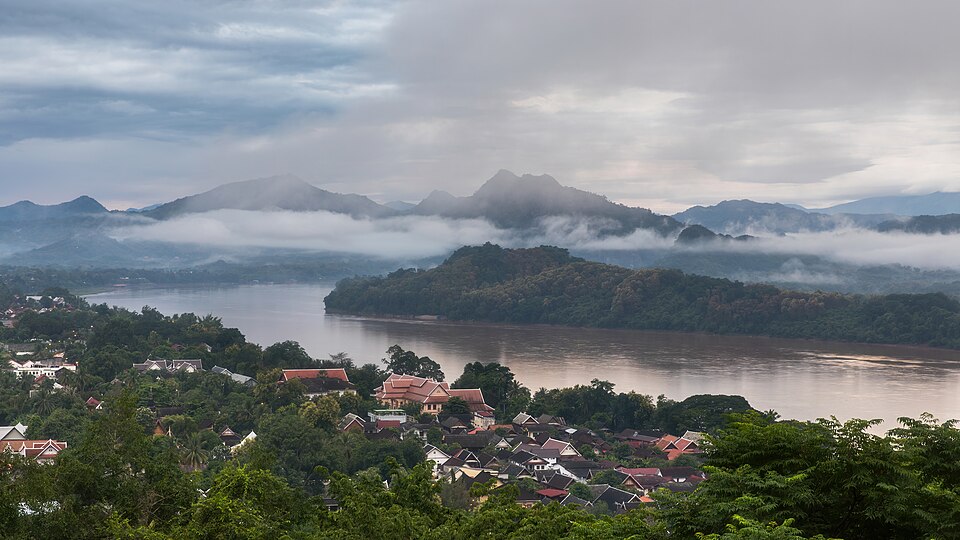
The shape of the place is easy to hold in your head. Luang Prabang sits on a narrow peninsula where the Nam Khan river meets the Mekong, a tongue of land maybe a few streets wide, water on two sides of it. I like a town I can understand geographically before I arrive, and this one I think I could walk end to end in an afternoon, which is exactly the scale that makes the tak bat possible: the monks live in the wats along the peninsula and the route is short enough that the whole town is inside it. The word wat is just temple, but it covers a lot, the grounds and the monks’ quarters and the sim, the ordination hall with the steep tiered roof that is usually the oldest and most careful building on the site.
There are a lot of them, more than thirty within the small historic core, and this is where the town gets strange in the way I find most appealing. When France ran Laos as a protectorate, it left behind the whole apparatus of a French provincial town: shuttered shophouses, wrought-iron balconies, and cafés that serve coffee and something close to a croissant. And then the empire left, and the cafés simply stayed. So you get a street where a gilded wat sits next to a French bakery next to another wat, and nobody seems to have decided this was incongruous. UNESCO listed the whole town as a World Heritage Site in 1995 partly for exactly this: the way the Lao Buddhist fabric and the colonial layer sit inside each other rather than one having paved the other over.
I’ll admit the risk in loving that from a distance. The colonial layer is easy to romanticize from a distance and it exists because of an occupation, and the tourism that now keeps the cafés full is the same tourism that has, by many accounts, started to bend the tak bat out of its own shape. That is the tension I’d carry with me if I went. I’ll come back to it.

The rivers, the hill, the market
If you want the town’s geography in one look, you climb Phousi, the hill that rises out of the middle of the peninsula. It’s a few hundred steps up past small shrines to a stupa at the top, and from there you can see both rivers at once and the roofs of the wats laid out below. Everyone goes up for sunset, which is precisely the sort of thing this pillar exists to send you away from, so I suspect the honest advice is to go up at some off hour when the light is flat and you have the steps mostly to yourself. I can’t confirm that from experience. It’s the kind of thing I’d want to get wrong once and then correct.
Down at the level of the streets, the main road is Sisavangvong, named for a king, and in the evening it becomes the night market. Vendors lay out textiles on the ground under low lights: the woven cloth of the region, indigo and deep red, some of it the work of Hmong makers from the surrounding hills. I’ve read enough to be wary of the market as a thing in itself. Markets aimed at visitors curdle fast. What pulls me is a few kilometers out, in a village called Ban Xang Khong along the Mekong, where weavers still make the pha sin, the wraparound silk skirt Lao women wear, on looms you can watch working. The pha sin is not a souvenir. It’s ordinary clothing, made well, and I’d rather stand in the room where one is being woven than buy a scarf under a market light.
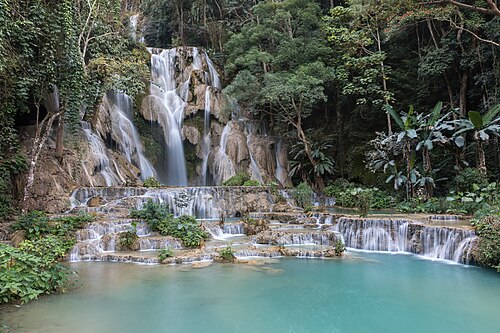
And there is the water itself. About thirty kilometers south of town, at Kuang Si, a stream drops through tiers of limestone into pools the color of turquoise, that particular blue that comes from calcium carbonate suspended in the water. It’s the one properly famous sight near Luang Prabang, which makes me instinctively want to schedule it for early and leave before the vans arrive. I notice I’m doing the thing again, planning the visit I haven’t earned, routing around crowds I’ve only read about.

The food is the argument
If a single detail convinces me a place has a real daily life and not just a heritage-listed surface, it’s usually a bowl of noodles eaten by people who aren’t thinking about it. For Luang Prabang that bowl is khao piak sen, a soft rice-noodle soup that people eat for breakfast, the noodles cut thick and a little chewy. That’s what I want to find on a side street at seven in the morning, after the monks have passed, in a place with four stools and no English menu.
The rest of the table I know mostly by name and reputation. There’s laap, the minced-meat salad sharp with lime and herbs and toasted rice, which is a dish of the wider Lao and northern Thai world and something close to a national dish here. There’s the sticky rice again, khao niao, arriving in its own small lidded bamboo basket, which is the utensil as much as the starch: you pull off a piece, roll it against your fingers, use it to lift everything else. I like a cuisine that hands you your own tool made of the staple food. It tells you where the center of the meal is.
I keep circling back to the mornings, though, because the mornings are the whole reason this town is on my list and not another one. Here is the honest limit, the one with a cost. I don’t know whether I’d have the nerve to kneel and offer rice, or whether I’d end up standing at the curb with a phone raised, which is precisely the behavior that has strained the ceremony to the point where the monks and the town have had to ask visitors to keep their distance and their flashes off. I want to believe I’d be the quiet one across the street with empty hands. I can’t promise that from here, and the not-knowing is part of why I want to go: to find out which kind of visitor I actually am when the line of bowls comes down the street in the dark.
The pull of Luang Prabang, as far as I can tell without having stood in it, isn’t any one of these things. It’s that the day has a shape, and the shape is set before dawn by an act of giving, and everything else, the cafés and the confluence and the noodles, arranges itself around that early quiet. I’d like to be there for one morning and find out whether the reading held.
The facts. Luang Prabang is the former royal capital of Laos, on a peninsula where the Nam Khan meets the Mekong in the country’s north. The historic town has been a UNESCO World Heritage Site since 1995. Getting there: most travelers fly into Luang Prabang International Airport or arrive overland from Vientiane. When to go: the cooler, drier months roughly November to February are the popular window; the wet season greens the falls but complicates travel. The one rule that matters most: the tak bat is a religious observance, not a performance. If you watch, watch from across the street, stay silent, don’t use flash, and don’t buy rice from vendors to hand out unless you understand the practice. Better to keep your distance and let it be what it is.
Sources
- Photo: Basile Morin, CC-BY-SA 4.0 · img/luang-prabang-phousi-sunrise.jpg
- Photo: Benh LIEU SONG, CC-BY-SA 3.0 · img/tak-bat-monks-dawn.jpg
- Photo: Basile Morin, CC-BY-SA 4.0 · img/kuang-si-falls-turquoise.jpg
- tourismluangprabang.org – Morning Alms
- UNESCO – Town of Luang Prabang
- Wikipedia – Luang Prabang
- tourismluangprabang.org – UNESCO World Heritage
- tourismluangprabang.org – Night Market
- Wikipedia – Sisavang Vong
- tourismluangprabang.org – Ban Xang Khong
- Wikipedia – Kuang Si Falls
- tourismluangprabang.org – Kuang Si Waterfall
- Wikipedia – Khao piak sen
- Wikipedia – Larb (laap)
- National Geographic – Luang Prabang food
- Fodor's – Tak Bat etiquette