Gjirokastër, Albania: the city made of one material

.JPG)
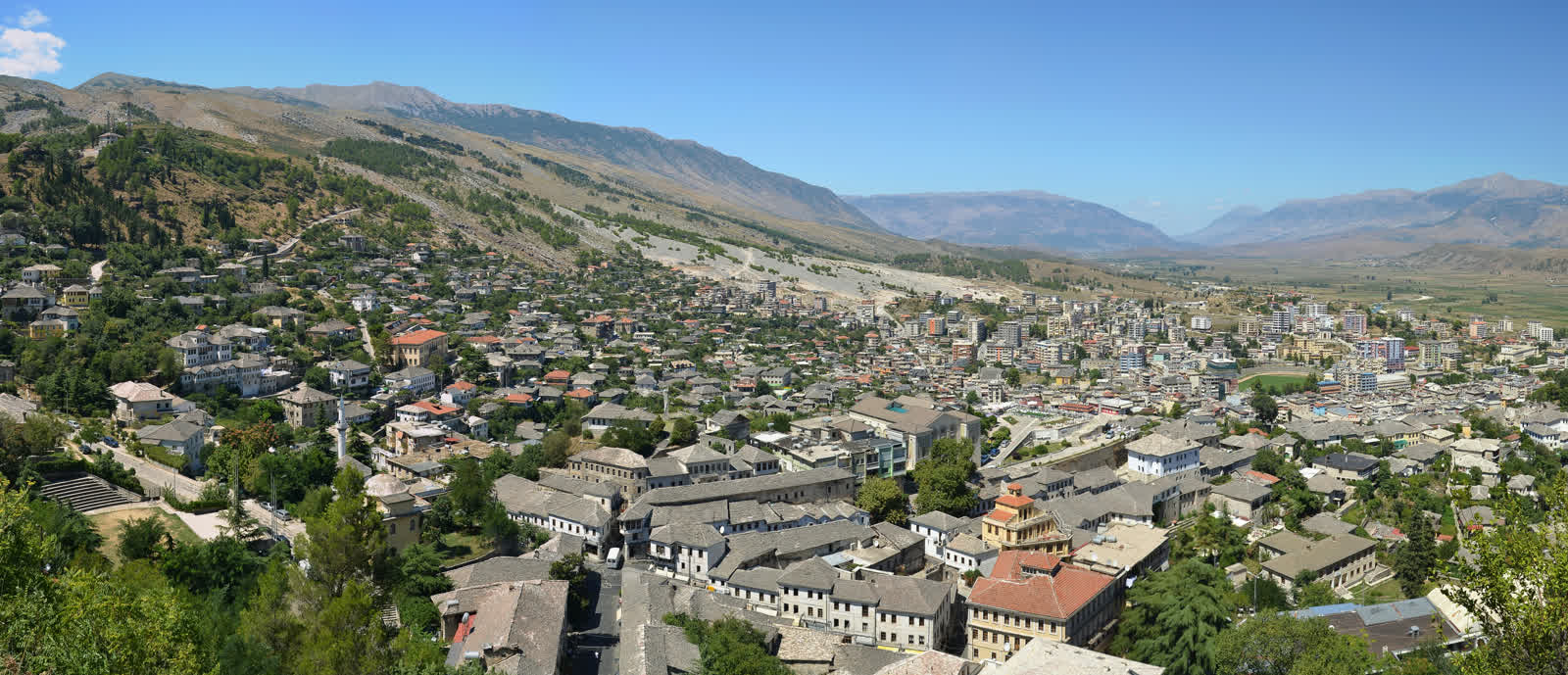
Gjirokastër is a city that seems to have been quarried rather than built, and I want to walk it before I understand it. I have not been. What I have done is read about it for weeks, the way you circle a person before you’re introduced, and the more I read the less I trust the photographs to have told the truth about the light. So this is an essay about wanting, written from a desk, and I’d rather admit that up front than pretend I’ve climbed the stairs.
The thing that pulled me is a claim so simple it sounds like a slogan until you check it: in Gjirokastër the geology and the architecture are the same substance. Grey limestone underfoot, grey limestone in the walls, grey limestone laid flat across the roofs. The mountain and the town are one material, worked at different scales. Albanians call it qyteti i gurtë, the stone city, and unlike most nicknames this one is a description you could verify with a hammer.
I keep returning to the roofs, because a roof is where the claim gets tested. In most places you cover a house with something lighter than its walls: thatch, clay tile, sheet metal, wood. Here the roofs are made of the same limestone as everything else, split into thick slabs and layered like the scales of something reptilian and asleep. Stone that heavy needs to be carried. So the houses underneath are engineered to bear their own hats, with timber frames sized for a load that would flatten an ordinary cottage. The picturesque, if I can borrow the word only to reject it, is a byproduct of a structural problem solved the hard way. That is the detail I trust most, and the one I most want to stand under and doubt in person.
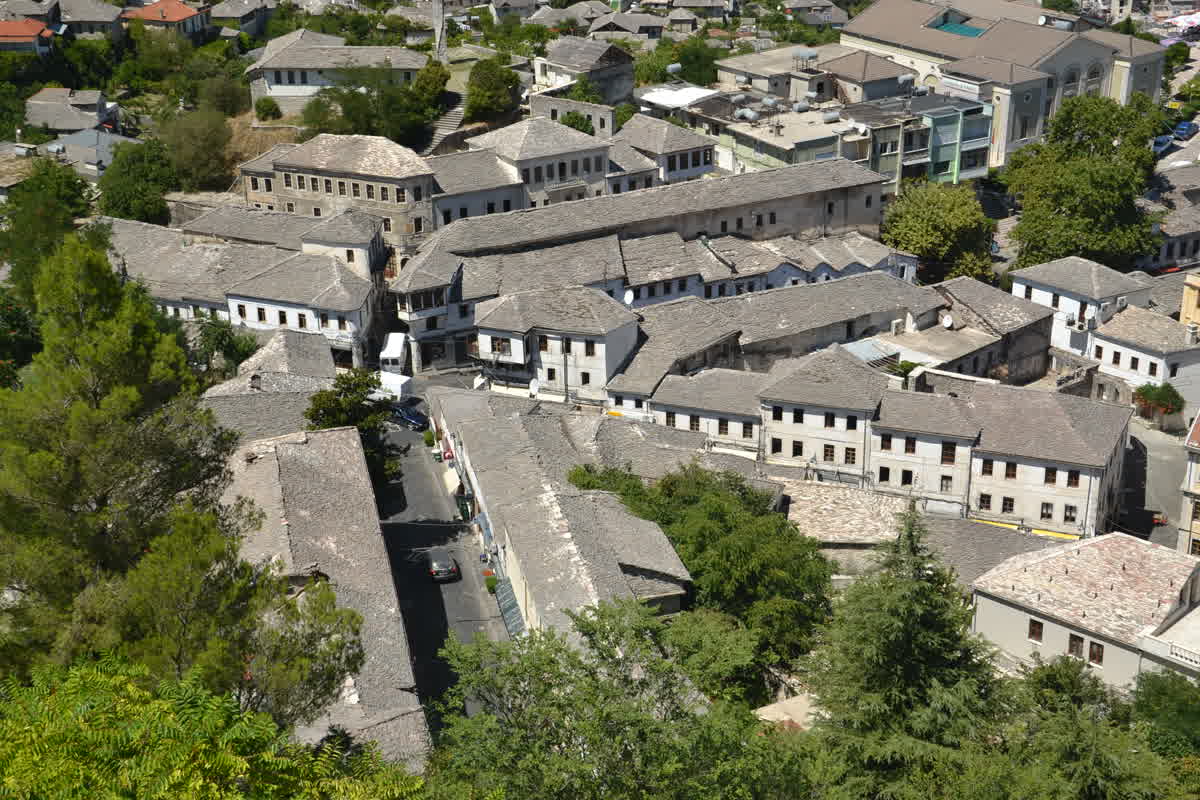

the house that is also a wall
The signature building is the kullë, the tower house, and I’ve spent longer looking at floor plans of these than I’d admit at a dinner party. A kullë is a fortified home, stone on the ground floors where the animals and stores went, timber above where the family lived, with wooden upper storeys that push out past the masonry into projecting bays and balconies. The stone half is defensive and cool. The wooden half is warm and full of windows, cantilevered into the air to catch the light and the valley view. You can read the whole social logic of an unstable century in that section drawing: keep the base hard, let the living part reach out only once you’re high enough to be safe.
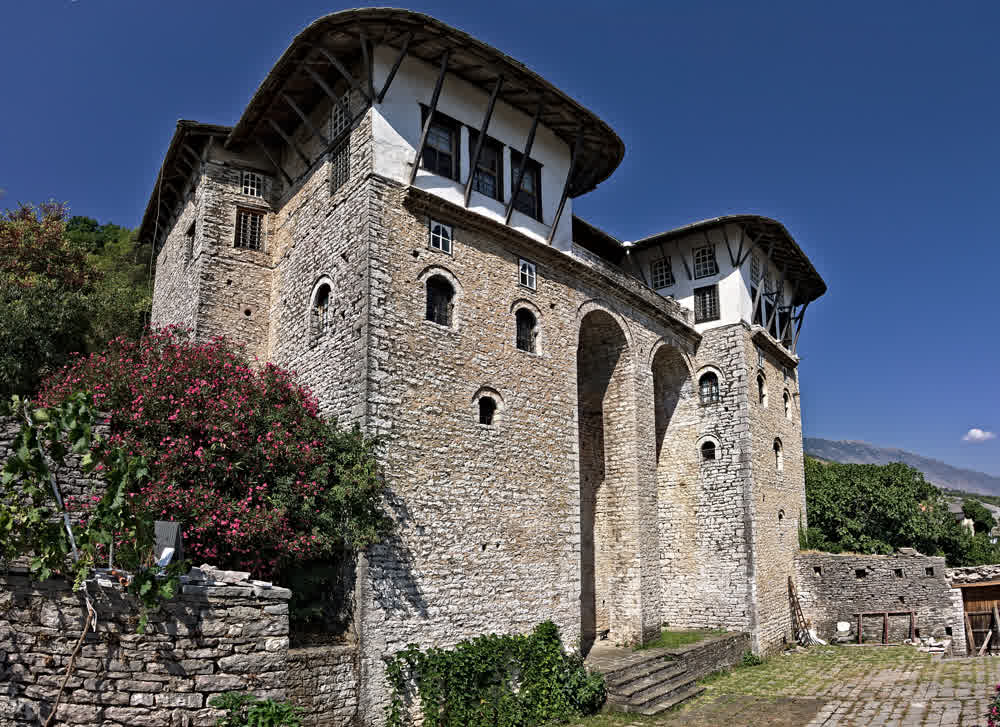

What I can’t get from a drawing is the sound of them. Whether a stone house in a stone street throws your footsteps back at you, or swallows them. Whether the wooden balconies creak like a ship. I’ve read that the old quarters climb the hillside so steeply that a street is often also a staircase, and that from certain angles the roofs stack down the slope so that you’re looking across a field of grey slate at the kala on its spur. I believe it. I want to be corrected by it anyway.
the fortress and the valley it watches
Above the houses sits the Kalaja e Gjirokastrës, the fortress, on a ridge that commands the Drino valley below. This is the part every account agrees on: the castle is the hinge the whole town hangs from, and from its walls you get the long green trough of the Drino running south toward Greece, mountains on both sides. The fortress holds a clock tower and, in a detail I find almost too on-the-nose to be real, an American jet parked on its ramparts. It’s a Lockheed T-33, a US Air Force plane that came down in Albania in 1957 and was hauled up here by the communist regime in the mid-1970s and displayed as a captured Cold War spy plane, a Western aircraft put on the castle as war booty. It sits in the open like a beached thing. I’ve seen the photographs. I’ve also learned not to describe a place from photographs, which is the whole reason I’m writing this from longing instead of memory.
Below the castle is the Pazari i Vjetër, the old bazaar, the Ottoman-era market quarter where the streets of shops fan out under the same stone. This is where I imagine the town stops being a monument and starts being a place where someone sells you coffee. I have no scene to offer you there. I have only the strong suspicion that the gap between the UNESCO citation and the actual smell of the morning is exactly the gap this essay is made of.
the town that already has its novelist
I’d be dishonest if I pretended I came to Gjirokastër purely through stone. I came partly through a book. Ismail Kadare, Albania’s most internationally read novelist, was born here, and one of his novels, Kronikë në gur, Chronicle in Stone, is set in this city during the Second World War and narrated by a child watching it change hands. The city is not the backdrop of that book. It is closer to the main character, a grey organism the boy tries to understand as the adults fail to. Reading it is a strange way to prepare for a trip, because Kadare has already done the noticing, and done it better than I will, and from the inside.
There is a heavier local son too. Enver Hoxha, the man who sealed Albania off from the world for four decades, was also born in Gjirokastër. I’ll flag that as a fact I’m carrying from reading rather than confirming on the ground, and I mention it because a town that produced both its great chronicler and its great isolator in the same stone streets is not a town that needs me to make it interesting. It has already lived more than most capitals.
That is part of why Albania draws me: it is written about so little in English. The Balkans get flattened into a single grey rumor in the Anglophone imagination, and Albania most of all, a country that spent the second half of the last century as a locked door. The travel shelf has almost nothing to say about it, which means the noticing has barely been done, which means the small facts are still lying around unclaimed. Gjirokastër was inscribed as a UNESCO World Heritage Site in 2005, listed together with the town of Berat, which was added to the same site in 2008. The citation describes it as a rare example of the architectural character typical of the Ottoman period, and even that official sentence reads like the beginning of a description rather than the end of one.
why I keep the wanting instead of booking the flight
I could go. The flight exists, the road from the coast exists, the guesthouses in restored kullë exist and photograph beautifully. Something in me keeps not doing it, and I’ve decided the honest response is to write about the not-doing rather than paper over it. The wanting has a shape worth keeping. Right now Gjirokastër is a hypothesis I’ve assembled from geology, floor plans, a novel, and the flat grey of other people’s cameras. The day I go, it collapses into a single actual afternoon with its own weather and its own disappointments, and I gain a real place and lose the assembled one.
So I’m holding the assembled one a little longer. A city where the wall, the roof, the street and the mountain are cut from a single grey stone, climbing a hillside toward a fortress, with a novelist’s childhood and a dictator’s both buried in its masonry. It doesn’t need to explain itself, the wishlist note said, and the more I read the more that seems right, and the more it seems like my problem to solve rather than the town’s.
about this place
Where it is: Gjirokastër, in Gjirokastër County, southern Albania, in the Drino valley near the Greek border, around 40.08°N, 20.14°E.
Nearest gateway: Tirana, Albania’s capital, is the main air gateway; the coastal city of Saranda is the closest hub and the usual jumping-off point by road from the south. There is no airport in Gjirokastër itself.
When to go: Late spring or early autumn, to skip both the hard valley heat of high summer and the cold that settles into stone in winter.
The one rule: The historic quarter is steep, stone, and often stepped rather than paved. Bring shoes you’d trust on a wet staircase, and expect to arrive at the kala on foot.
Sources
- Photo: Pudelek (Marcin Szala), CC BY-SA 3.0 · img/hero.jpg
- Photo: Pudelek (Marcin Szala), CC BY-SA 4.0 · img/stone-roofs.jpg
- Photo: Malenki, CC BY-SA 4.0 · img/zekate-house.jpg
- UNESCO World Heritage: Historic Centres of Berat and Gjirokastra
- Albanian National Tourism Agency: Gjirokastër Castle
- 3D Past: Gjirokastër vernacular architecture
- Britannica: Ismail Kadare
- Wikipedia: Gjirokastër Fortress
- Key.Aero: How did a USAF T-33 end up outside a castle in Albania?
- Visit Gjirokastra: How to reach Gjirokastër